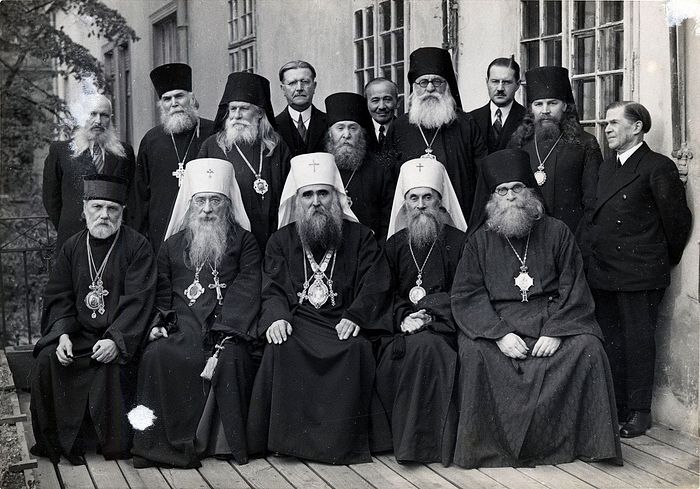
The meeting of the overseas Russian bishops under the chairmanship of the Patriarch of Serbian Varnava in Sremsky Karlovtsy, at which the “Provisional Regulations on the Russian Orthodox Church Outside of Russia.” Metropolitan Anastassy (Gribanovsky), Bishop Dimitry (Voznesensky)
The position of the Russian Orthodox Church Outside of Russia (ROCOR) during the years of the Second World War has not yet become the subject of much research and is still distorted. Unfortunately, during the Soviet period, all the works devoted to this topic had not so much a scientific as an ideological character. A distinctive feature of these works was the accusations of the Church Abroad in support of Hitler's Germany. Especially in these writings metropolitan Anastasia (Gribanovsky), who headed the Russian Church Abroad during the Second World War
[1] . Similar accusations were made by the Moscow Patriarchate. Thus, in June 1945, in the process of preparing a pan-Orthodox condemnation of the Church Abroad, the Moscow Patriarchate prepared a preliminary memorandum signed by the Patriarch of Alexandria, the Antioch, Moscow and Jerusalem. Among the accusations against the ROCOR contained the following clause: “treason against the common Christian cause of fighting fascism”
[2] . There is reason to believe that Patriarch Alexy I himself did not want this condemnation, but acted under state pressure
[3] . Scheduled conviction failed. Firstly, the idea was not supported by Constantinople, and secondly, the Pan-Orthodox Council was necessary for the condemnation, at which extremely uncomfortable questions for the Soviet leadership could be raised. But the opinion of the ROCOR, as an organization that supported Hitler, still exists even in the church environment. At the same time, the non-seriousness of the approach to the question is indicated, among other things, by frequent references to Archimandrite Ioann (Shakhovsky) and his article “The Hour is Near”
[4] . The fact is that Archimandrite John was under the authority of the Russian Western European Exarchate of the Church of Constantinople and had no relation to ROCOR.
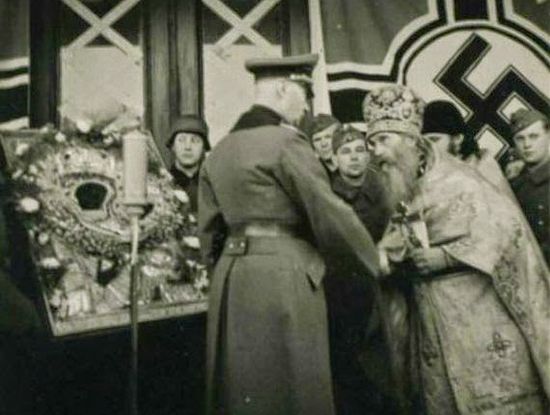
What is the position of the Russian Church Abroad in fact?
At first glance, it may seem that she really had grounds for supporting Germany. On the territory of the Reich, the ROCOR had a diocese, and its position was more favorable compared to dioceses in other countries, including Yugoslavia. In the early 1930s. The Foreign Synod did not exclude the possibility of moving to Germany
[5] . Since March 1936, the government of Prussia issued a decree granting the status of a public law corporation to the Orthodox Berlin and German Diocese of ROCOR. This ruling was extended to other lands of the country
[6] . Thus, the Diocese of the ROCOR became the only legal Orthodox structure in Germany. In 1938, the bishop also changed here. They became an ethnic German, bishop (later Metropolitan) Seraphim (Lyade). In the same year, with the German help in the center of Berlin, the Cathedral of the Resurrection was completed.
Not only a significant part of the Germans, but also a considerable part of the Russian emigration, saw in Hitler a leader who saved the country from the humiliating consequences of the First World War and was ready to oppose the world communist camp. Therefore, at a certain stage, the support of the Fuhrer could have been sincere. In the Berlin Diocese of the ROCOR, commemoration of the state leadership was introduced. On June 8, 1936, the Synod of Bishops prescribed the following formula for the Führer's commemoration. On the great litany in the temples of the ROCOR in Germany, it was necessary to proclaim: "On the Christ-loving Leader of the people of Germany, his government and army, let us pray to the Lord." On a special litany: “We also pray for the Christ-loving Leader of the German People, for power, victory, stay, peace, health, their salvation and the Lord God, most likely, hurry and help them in all and subdue under the nosyaz of every enemy and adversary”
[7] .
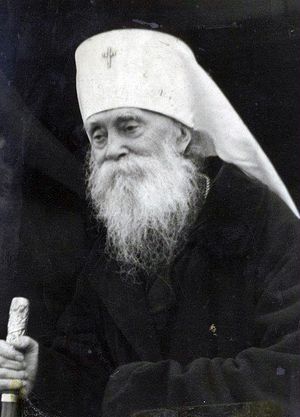
Metropolitan Anastassy (Gribanovsky)
Another event linking the ROCOR with the German government is the well-known grateful address of Metropolitan Anastassy (Gribanovsky) (June 1938), read at the consecration of the cathedral in Berlin. In his message, the metropolitan not only thanked the Führer for his help in building the temple, but also blessed him to fight against the forces “wanting to destroy our people too”, that is, the communists. “This temple,” the document said, “strengthens our hope that the end of history has not yet come to our long-suffering homeland, and that the Commander of history will send the Leader to us, and this Leader will resurrect our Homeland, just as He sent You to the German people. " After that, a prayer was said for the leader and the state chancellor
[8] .
These two facts (the commemoration of Hitler in the Berlin Diocese and the grateful address of Metropolitan Anastassy) still remain the subject of complaints against Metropolitan Anastassy. It does not take into account that the formula of commemoration and a thank-you message were compiled even before the “crystal night” (November 1938), after which the essence of the Hitler regime became obvious, and more than a year before the start of World War II. Since no one considered Hitler to be a criminal, it is not surprising that in those years no complaints against Metropolitan Anastassy came from any of the Local Churches. At the consecration of the Resurrection Cathedral were attended by representatives of the Serbian and Bulgarian Churches. And the Patriarch of Antioch, Alexander III, and the head of the Church of Greece, Archbishop Chrysostom, in their letters to Metropolitan Anastasia, expressed their joy at the help of the “great German government”
[9] .
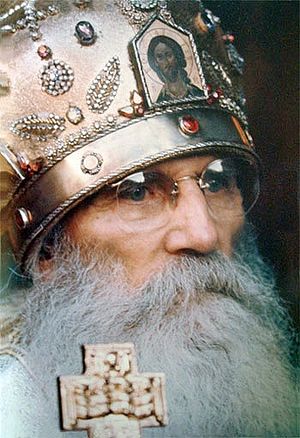
Archimandrite Anthony (Sinkevich)
Archimandrite (later Archbishop) Anthony (Sinkevich), later justifying Metropolitan Anastasia, wrote: if the Moscow church authorities considered the German authorities so criminal, then why didn’t she condemn her government for an alliance with Hitler in 1939?
[10] The same idea was expressed in 1946 by Archbishop Leonty (Turkevich), the future head of the North American metropolis: “As for the letter to Vl [adyk] M [itropolit] Anastasia, thanking for the construction of the church in Berlin, then if he put it to blame, why not blame Joseph Vissarionovich for his intercourse with the Nazis in the same years? Must be the same judgment. And besides, it was all BEFORE THE WAR "
[11] .
In parallel with this, in the second half of the 1930s. there is also a growing mistrust of the ROCOR leadership towards the Nazi regime. In 1936, at the St. Vladimir's celebration in Belgrade, Metropolitan Anastasius said that fascism cannot be the Russian ideal, because it suppresses human freedom, without which an Orthodox state is unthinkable
[12] . Dissatisfaction with the ideology of National Socialism was also apparent in the speeches of delegates to the Second All-Diaspora Council in 1938.
[13] In the Russian Church Abroad, the liberation of Russia from the communist regime at that time was associated with other ideas, and above all with the monarchist idea.
The Second All-Diaspora Council noted that Russia's misfortunes stemmed from the fact that it retreated from its Christian mission and rejected the king. The people exchanged their mission for the promise of a lentil soup of earthly paradise and as a result turned out to be in a terrible God-fighting slavery. The Council called the restoration of the Orthodox monarchy a condition for saving Russia. In the face of the coming shocks, the Council called on emigration to rally around the Orthodox Church and specifically around the head of the ROCOR, Metropolitan Anastassy
[14] .
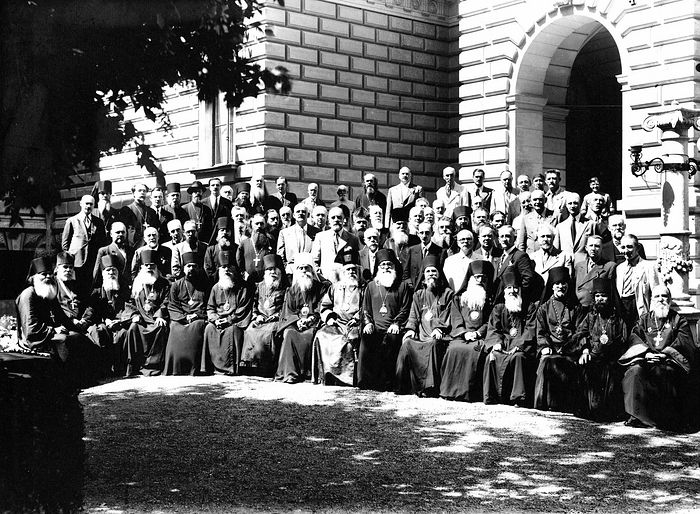
Second All-Diaspora Cathedral
A year later, the Russian Church Abroad corrected its position, which was due to the premonition of the imminent war between Germany and the Soviet Union. War seemed imminent. The relevant prophecies were published in the emigrant press. For example, words were attributed to Patriarch Tikhon that he would outlast Lenin, and the Soviet power would fall 15 years after his Most Holy death. They also pointed to the words of the
Rev. Nectarius of Optina , that after the regicide (1918), the Russian people were allowed 22 years to repent. "Orthodox Russia" published the words of St. Seraphim of Sarov about the terrible bloodshed that will be sent to Russia for cleansing. They were popular in the late 1930s. and other prophecies
[15] .
September 12, 1939, that is, at the very beginning of the Second World War, the ROCOR Bishops' Council was held in Yugoslavia. On the very first day of the Council, a message was unanimously received by Grand Duke Vladimir Kirillovich Romanov, in which he was in fact recognized as the leader of the Russian people. "The Cathedral diligently prays to the Divine World Governor, grant you wisdom to comprehend the signs of the times and clothe you with strength and courage in order to enter the great cause of liberation at the appropriate time by the enslaved godless power of the Native Earth, uniting the whole Russian people around itself," the message said
[ 16] . The same Council declared on September 14 that now emigration should unite around Vladimir Kirillovich, and there is no need for the existence of a second center in the person of the Synod of Bishops. It can be said that the leadership of a future free Russia from the Bolsheviks has already been blessed by the Russian Church Abroad
[17] .
Germany’s attack on the Soviet Union took place against this background. On the one hand, this background was an expectation of the liberation of Russia from the communist dictatorship, on the other hand - distrust of Hitler.
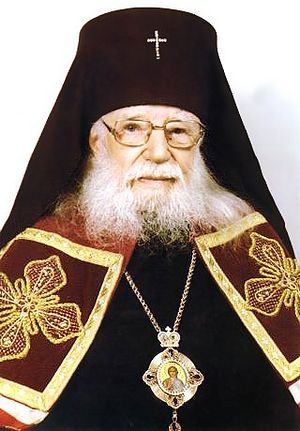
Archbishop Seraphim (Ivanov)
This duality was reflected in the editorial article of the journal "Orthodox Russia" (June 1941). The author of the article, Archimandrite Seraphim (Ivanov), did not welcome the attack, but spoke of it as the beginning of the restoration of Russia. Archimandrite cited the prophecy of the Monk Aristocracy (Amvrosiyev): “At the command of God, the Germans will enter Russia and save her, but they will not stay in Russia and go to their country”
[18] . In this connection, the author of the article recalled Emperor Alexander I, who liberated Europe from Napoleon, but did not take over Germany and France. But is it possible to pin such hopes on Hitler? The author of those articles did not feed. On the contrary, he warned that there is no reason to hope for the nobility of Hitler, and instead of re-creating Russia, its dismemberment could occur. It will be based on the national republics artificially created by the Bolsheviks
[19] .
In the future, representatives of the ROCOR looked at this war in their own way, there was no single attitude to it. There were no official orders about the attitude of the Church Abroad to this war.
To understand this situation, we must remember that none of the states (including Germany) could influence the Church Abroad as a whole - its dioceses were located in different countries, on different continents. The Nazi regime could not subjugate all the eparchies of the ROCOR. In addition, the Foreign Synod during the war years was actually cut off from most of its dioceses and did not have the opportunity to send circulars. It is clear that the anti-Hitler speeches of the German cleric would not have remained without punishment. However, a priest in the neighboring Great Britain or Switzerland could bravely oppose Hitlerism. And the pro-German speeches of the ROCOR cleric in America after her entry into the war could have ended for the hapless preacher and criminal prosecution.
Therefore, it is not surprising that the statements about Hitler of the ROCA hierarchs during the war years were different.
Some hierarchs, such as, for example, the archbishops Seraphim (Lukyanov) and Hermogenes (Maximov), considered Hitler the savior of Europe
[20] . Archbishop Seraphim (Lukyanov), who ruled the Western European Diocese of ROCOR and found himself in occupied France, is entitled “To the Faithful Sons of Russia”, which referred to Hitler’s crusade against world atheism. “May the devilish gang of villains who have crucified Russia perish,” the archbishop wrote. - May the Masonic star, hammer and sickle disappear from the face of the earth. Yes, the Cross of Christ will shine on the native Earth and in the whole Universe <...> Long live the Great National Russia ”. To understand the degree of sincerity of this hierarch is not an easy task, because at the end of the war he began to sing the Soviet system with no less enthusiasm.
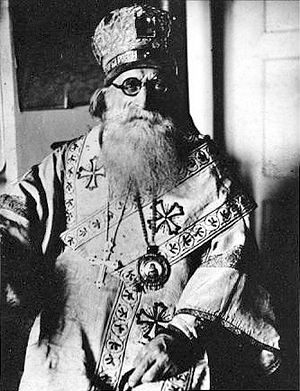
Metropolitan Seraphim (Lyade)
The Western European archbishop was echoed by the head of the German diocese, Archbishop Seraphim (Lyade). In his pastoral address on June 22, 1941, he declared that the war had begun not against the Russian people, but only against the Soviet government with its “devilish anti-religious and communist propaganda”
[21] . Subsequently, Metropolitan Seraphim (Lyade) in the messages was supported by the German government.
Some other hierarchs did not sympathize with the Soviet Union. One of the most respected Russian bishops in the United States, Archbishop Vitaly (Maksimenko), addressed a message to American President F. Roosevelt with a request not to render assistance to the communist state. The message indicated that power in Russia was illegitimate, that it had been seized by a group of conspirators — the Comintern, whose goal is to overthrow the legitimate world governments. Assistance to the Soviet state is impossible due to the fact that it is working against the United States, funding local communists and encouraging class hatred. Finally, the power in the Soviet Union remains anti-Russian and continues terror against the Church
[22] .
Archbishop Theodosius (Samoilovich) took a sharp anti-Soviet stance in ROCA in South America. He wrote that praying for the Soviet government was “serving the devil”
[23] .
But there was the opposite attitude towards war. St. Seraphim (Sobolev) who ruled the Russian parishes in Bulgaria never served as a prayer for Germany’s victory, and the archpastor’s spiritual children, Archimandrite (later Bishop) Parthenius (Stamatov) and Archimandrite Methodius (Zherev), maintained contact with the anti-fascist underground in Bulgaria
[24] .
The head of the North American Metropolitan ROCOR, Metropolitan Theophilus (Pashkovsky), and also some other North American hierarchs during the war years prayed for the victory of the Soviet Union
[25] .
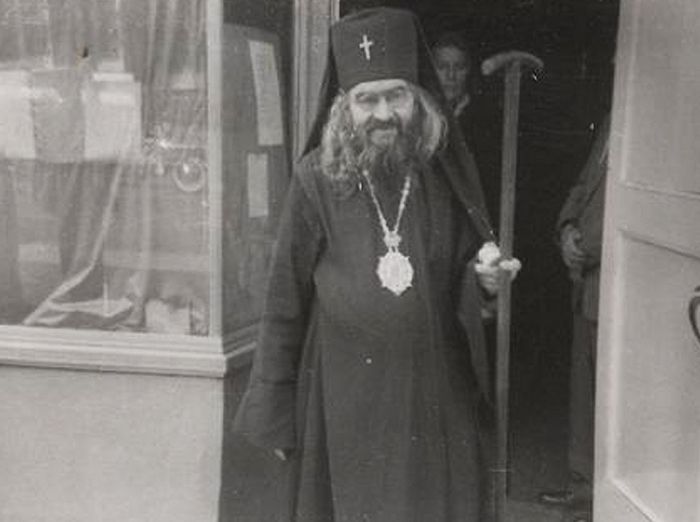
St. John (Maksimovich)
Some archpastors changed their position during the war.
St. John (Maximovich) , Bishop of Shanghai, in the early years of the war, prayed for the victory of Germany and changed his position only at the beginning of 1943. From that time he began to pray for the victory of the Red Army
[26] . There is information that the saint made money collections for her needs
[27] . In 1945, the archpastor made a thanksgiving prayer service in connection with the victory of the countries of the anti-Hitler coalition.
The position of the head of the ROCOR, Metropolitan Anastasia, deserves special consideration. He did not want to be under the influence of the Hitler administration, and in 1941 he even made an attempt to move from Yugoslavia to Switzerland
[28] . The move did not take place, Metropolitan Anastasius remained in Belgrade.
Already in the first months after the German attack on the Soviet Union, it became clear that the Russian Church Abroad with the National Socialists was not on the way. Hitler, who sought to dismember Russia, tried to prevent a single Orthodox Church on its territory.
On August 16, the chief of the security police and SD, R. Heydrich, signed Operational Order No. 10, based on the Fuhrer's directives. The order directly stated that there can be no talk of supporting Orthodoxy and re-establishing the Patriarchal Russian Church. On the contrary, splitting and fragmentation of church groups was encouraged
[29] . A. Resenberg, Reich Minister of Eastern Territories, spoke against Orthodoxy as a unifying Russian force. His secret instruction dated May 13, 1942 stated that in the occupied territories any religious community should be limited to the confines of one region, and the Russian Church should not be allowed access to the spiritual leadership in Belarus and Ukraine.
In accordance with the instructions of Hitler, on August 6, 1941, an order appeared signed by the commander-in-chief of the German armed forces, V. Keitel, prohibiting the engagement of clergy from abroad in activities in the "eastern territories". This prohibition, which concerned primarily the Russian Church Abroad, was repeated in other orders of the German departments
[30] . Because of the distrust of the ROCOR, different jurisdictions operated in the occupied territories - the Patriarchate of Constantinople, the Romanian Church, the Belarusian and Ukrainian Autonomous Churches, the openly schismatic “Ukrainian Autocephalous Church”, the parishes of the Moscow Patriarchate, the Renovationists. The Germans did not allow representatives of the Russian Church Abroad into the occupied territories - its patriotic, monarchical and Great Russian ideas did not fit into German plans at all. When organizing church structures in the occupied territories, the Nazis stipulated a condition not to enter into contacts with the Church Abroad
[31] . Attempts by the latter to send their clerics to the Russian regions captured by Germany ended in failure.
In September 1942, the clergy of the Smolensk and Oryol regions, who did not wish to submit to the newly formed Belarusian Church, appealed to Metropolitan Seraphim (Lyada) of Germany. The clergy declared that they wanted to obey the ROCOR and asked them to send a bishop to Orel. On November 19, the Synod of Bishops proposed that Metropolitan Seraphim take measures to send bishops to Smolensk and Orel and organize church life there
[32] . However, this decision remained on paper - Metropolitan Seraphim (Lyada) could not send not only a bishop, but also a deacon to Smolensk and Orel. Moreover, the Russian Orthodox Church Outside of Russia was actually forbidden even to feed some of the German territories. We are talking about the Diocese of Bialystok-Grodno, Germany included in East Prussia. Although this diocese was to be governed by the Berlin-German bishop, in fact the diocese was ruled by the Belarusian Church as a kind of “foreign Belarusian exarchate”
[33] .
A similar situation was in Ukraine. In 1942, the initiative group of the Ukrainian Autonomous Church, consisting of the bishops Panteleimon (Rudyk), Veniamin (Novitsky) and Dimitry (Magan), appealed to Metropolitan Seraphim (Lyade) to accept the Ukrainian Church. Metropolitan Seraphim advised the hierarchs to turn to the Reich Commissar of Ukraine
[34] . As a result, the ROCA was not allowed to enter Ukraine’s territory, and the request of the Ukrainian hierarchs remained without consequences.
S.V. Troitsky, referring to the letters of Metropolitan Seraphim (Lyada), spoke about the material assistance of the German Government of the Church Abroad
[35] . However, studies carried out in the archives of the Nazi departments suggest that the provision of material support to the ROCOR during the war years was out of the question, and the German Diocese remained one of the poorest in the Church Abroad
[36] .
Only very few priests who were attached to the Russian anti-Soviet formations got into the occupied territories from the clerics of the ROCOR.
In Europe, the activities of the ROCOR during the war years were also seriously limited. The sovereigns of the Russian Church Abroad did not allow the Hitlerite leadership to convene, despite the constant attempts of Metropolitan Anastassy to get them convened. The only case is the permission to hold the Vienna Conference in October 1943, which opposed the election of Patriarch Sergius in Moscow. But in this case, we can confidently say that this statement of the Vienna Conference was not the result of pressure from the Hitler state. First, Metropolitan Anastasius, before the Vienna Conference, spoke about electing Patriarch Sergius as an anti-canonical act and compared the assignment of Patriarch Sergius with the appointment of Patriarch Ignatius under False Dmitry I - both were ordered by dictators, although with subsequent subsequent approval by the Council of Bishops
[37] . Secondly, the meeting participants criticized the position of Germany regarding the Church and the Orthodox population.
The last decision was logical. During the entire period of the Second World War, the ROCOR was oppressed by the German government. After the occupation of Yugoslavia by Hitler Germany, the Gestapo organized a search in the apartment of Metropolitan Anastassy on Krunskaya Street, 20. The work of the Synod of Bishops was also seized
[38] . At one time, the temples in Leipzig and Dresden were threatened with closure. The closure did not take place solely because of the fear that such an action would worsen relations with the German allies - Romania and Bulgaria
[39] .
I met obstacles and the educational activities of the Church Abroad. Until mid-1942 there was a ban on the import of literature published by the monastery of St. Job in Ladomirovo to the territory of the Reich, Bohemia and Moravia, Belgium, Holland and Serbia. In subsequent years of war, these areas were allowed to distribute literature only in churches or by subscription
[40] . On the part of the clergy of the Russian Church Abroad, repeated attempts were made to render pastoral assistance to prisoners of war, as well as to workers who had been taken to work in Germany. However, the German leadership has obstructed here too. With great difficulty, Metropolitan Seraphim (Lyada) managed to get permission to appoint 15 traveling priests who visited the camps. But in practice, the activities of these shepherds depended on the local authorities, who, at their own discretion, decided on the admission of the clergy to the camps
[41] .
The position of the ROCOR during the war years was complicated by the impossibility of communication between the Synod of Bishops and the dioceses. Metropolitan Anastasius believed that the obstacles to the normal activities of the Synod were part of German policy. Moreover, the situation did not change even during the agony of the Hitler regime
[42] .
The attitude of Metropolitan Anastasia to the Nazi authorities was also manifested in the fact that he did not agree with the demand to issue an appeal to the Russian people to fight on the side of Germany. Metropolitan Anastassy justified his refusal by saying that the real goals of Germany towards Russia are unknown to him
[43] . During the war years, the Synod did not have instructions to pray for the victory of Germany, on the contrary, such prayers were even forbidden
[44] . Although the Easter message of Metropolitan Anastasia of 1942 contained the words about the “courageous German sword”
[45] , this was far from what the hierarch Germany had expected. Neither the messages with the support of Hitler, nor the synodal definitions on the part of the ROCOR, the Nazis did not wait.
What can really be blamed on Metropolitan Anastasia is the blessing given to the Russian guard group, transformed in 1943 into the Russian guard corps, and the Russian Liberation Army A.A. Vlasov. However, let us leave this fact on the conscience of Metropolitan Anastasia himself - this decision was not discussed at the conciliar or synodal level and could not be discussed. Other archpastors and clerics of the Russian Church Abroad quite calmly expressed the opposite point of view on the Vlasov movement. For example, St. Seraphim (Sobolev) forbade Russian émigrés to join Russian anti-Soviet formations, insisting that it was a sin to fight against their homeland
[46] .
It is noteworthy that the Serbian Church, more than the other Local Churches suffered from Nazi Germany, treated the behavior of Metropolitan Anastasia during the war years with understanding. Patriarch Serbian Gabriel later turned to the public with words in defense of Metropolitan Anastasia: "Metropolitan Anastassy with great wisdom and tact was held by the Germans, was always loyal to the Serbs, was searched several times and did not enjoy the confidence of the Germans"
[47] .
The head of the North American Metropolitan Church of the ROCOR, Metropolitan Theophilus (Pashkovsky), also wrote that Metropolitan Anastasius was not associated with the regime of the national socialists. In 1946, he supported Metropolitan Anastasia, who at that time was able to move to Switzerland and was engaged in the revival of the Russian Church Abroad. Local communists tried to achieve the expulsion of Metropolitan Anastasia from the country. The letter of Metropolitan Theophilus to the President of Switzerland at that moment helped Metropolitan Anastasia. The head of the North American metropolis wrote: “Metropolitan Anastassy manages our Church outside of Russia in the best possible way and is a man of higher ecclesiastical principles and a good life, without interfering with politics. The current campaign of the communist press against him is extremely sad and undesirable and should be ignored. Therefore, I respectfully ask Your Excellency to allow him to remain in Switzerland for the benefit of the Russian Church and the people in Europe ”
[48] . Thanks to this letter, the attacks on the Metropolitan gradually faded away
[49] .
Thus, it can be said that the accusations of the Russian Church Abroad in supporting Nazi Germany are unfounded. The statements of individual hierarchs in support of Germany are their private opinion and remain on their conscience. Moreover, the Russian Orthodox Church Outside of Russia had opposite examples when the archpastors of the Church Abroad did not hide their negative attitude towards Nazism and the war on its side. The Hitler regime did not receive the blessing of the Russian Church Abroad for a war against the fatherland. The principles of the existence of the ROCOR, based on the idea of a great, united, monarchical Russia, did not allow the Church Abroad to support Germany in this war.
Notes:
[1] See eg.: Gordienko N., Komarov P., Kurochkin P. Politicans of religion. The truth about the "Russian Church Abroad." M., 1975. S. 54; Sulackov A. They write letters provokers. Alma-Ata, 1973. S. Troitsky . About the iniquity of the Karlovac split Editions de L'Exarchat Russe en Europe Occidentale. Repr M. 1992 S. 94 - 96 and others.
[2] DECR archive. D. “Russian Church Abroad”. P. "1945". L. 34 - 34 about. Publ. in: Kostryukov A. Russian Church Abroad in 1939-1964 Administrative structure and relations with the Church in the Fatherland. M. 2015. p. 373 - 374.
[3] This assumption is supported by the fact that Patriarch Alexy I served the requiem for the ROCOR head to Metropolitan Anthony (Khrapovitsky) in 1957, the fact that an overwhelming majority of ROCOR representatives were accepted to the Moscow Patriarchate, etc.
[4] New word (Berlin). No. 27 of 06/29/1941.
[5] DECR archive. The case "Metropolitan Sergius. Correspondence. Western Europe". Folder "1931 - 1933". L. 115 about.
[6] Nikitin A. The Nazi regime and the Russian Orthodox community in Germany (1933 - 1945). M. 1998. S. 116 - 119.
[7] See: Definitions of the Synod of Bishops of the Russian Orthodox Church Outside of Russia // Church Life. 1936. No. 7. S. 99.
[8] Sanctification of the Berlin Cathedral // Church Life. 1938. № 5 - 6. P. 93 - 96; Malice or folly? // Morning Dawn. 1938. № 10 - 11. P. 84-85; The German press on the consecration of the Russian Orthodox Cathedral in Berlin // Church Life. 1938. No. 7. S. 110.
[9] Diploma of the Patriarch of Antioch to the Chairman of the Synod of Bishops // Church Life. 1939. No. 7. S. 101; Diploma of the Archbishop of Hellas to the Chairman of the Synod of Bishops // Church Life. 1939. No. 7. S. 102.
[10] Anthony (Sinkevich), archim . Letter igum. Nikon 09/28/1945 // Archives of the Russian Ecclesiastical Mission in Jerusalem. D. 225-n "Archimandrite Nikon".
[11] Leonty (Turkevich), Archbishop . A letter to the archbishop. Vitaly (Maksimenko) September 5, 1946 // Archive of Holy Trinity Seminary in Jordanville. F. “Talberg”. B. 13. F. 6.
[12] Jubilee collection commemorating the 150th anniversary of the Russian Orthodox Church in North America. Part 2, New York. 1945. p. 34.
[13] See: Acts of the Second All-Diaspora Council of the Russian Orthodox Church Outside of Russia with the participation of representatives of the clergy and laity, held on 1/14 - 11/24 August 1938 in Sremsky Karlovtsy in Yugoslavia. Belgrade, 1939. p. 460, 520.
[14] Ibid. S. 682 - 703.
[15] See ..: Prophecies about the Russian distemper // Heavenly Bread. 1941. No. 1. S. 48; Prediction of prep. Seraphim of Sarovsky about the Russian distemper // Orthodox Russia. 1941. No. 12. S. 2.
[16] GA RF. F. 6343. Op. 1. D. 22. L. 2 vol. - 3.
[17] GA RF. F. 6343. Op. 1. D. 22. L. 8.
[18] Sursky I. Father John of Kronstadt. Belgrade, 1938. p. 196.
[19] Seraphim, Archim . “Lord Jesus Christ, raise holy Orthodox Russia!” // Orthodox Russia. 1941. No. 12. S. 1.
[20] Kosik V. The Croatian Orthodox Church (from organization to liquidation) (1942–1945). A look from the 21st century. M., 2012. P. 42.
[21] Nikitin A. The Nazi regime and the Russian Orthodox community in Germany. S. 402, 403.
[22] Vitaly (Maksimenko), Archbishop . The motives of my life. New York. Jordanville Bd Pp. 162 - 163.
[23] Theodosius (Samoilovich), Archbishop . A letter to a certain hierarch of 09/03/1941 // Archives of Holy Trinity Seminary in Jordanville. F. “Talberg”. B. 1. F. 9.
[24] GA RF. F. 6991. Op. 1. D. 132. L. 216.
[25] Theodosius (Samoilovich), Archbishop . A letter to a certain hierarch of 09/03/1941 // Archives of Holy Trinity Seminary in Jordanville. F. “Talberg”. B. 1. F. 9.
[26] GA RF. F. 6991. Op. 7. D. 28. L. 23.
[27] Pozdnyaev D., priest . Acceptance of the jurisdiction of the Moscow Patriarchate and church schism in Shanghai // Alpha and Omega.1997. № 2 (13). P. 166.
[28] Gregory (Grabbe), Bishop . The covenant of the holy patriarch. M. 1996. p. 323.
[29] M. Shkarovsky. The policy of the Third Reich towards the Russian Orthodox Church in the light of archival materials of 1935-1945. M. 2003. S. 183 - 185. Nikitin A . The Nazi regime and the Russian Orthodox community in Germany. Pp. 312-313.
[30] See .: Shkarovsky M . Nazi Germany and the Orthodox Church. M. 2002. S. 157 - 158, 190.
[31] Alekseev . The Orthodox Church in the German-occupied territory of Russia in 1941-1944. // Church life // Church life. 1957. № 1 - 3. S. 31.
[32] Minutes of the meeting of the Synod of Bishops 19.11.1942 // Archives of the Synod of Bishops of ROCOR. The case of "Metropolitan Anastasius." K. 1.
[33] Alekseev . The Orthodox Church in the German-occupied territory of Russia in 1941-1944. // Church life // Church life. 1957. № 1 - 3. S. 31.
[34] The Russian Orthodox Church during the Great Patriotic War of 1941-1945. Collection of documents. Sost: Vasilyeva O.Yu., Kudryavtsev I.I., Lykova L.A. M., 2009 p. 644 - 645.
[35] S. Troitsky About the Karlovatsky schism's iniquity. P. 98 - 99.
[36] Nikitin A. The Nazi regime and the Russian Orthodox community in Germany. P. 39.
[37] Anastasius, Met. Regarding the election of the Patriarchal Throne of the Patriarchal Throne, Metropolitan Sergius, to the Patriarchal Throne, the Church Life. 1943 № 9. S. 125 - 131.
[38] To the centenary of birth. The Most Blessed Metropolitan Anastasius // Church Life. 1973. No. 5 - 7.S. 45.
[39] M. Shkarovsky. Nazi Germany and the Orthodox Church. Pp. 249 - 252.
[40] Nikitin . The Nazi regime and the Russian Orthodox community in Germany. S. 338.
[41] Kornilov A. Transformation of Russia. Nizhny Novgorod. 2000. p. 87.
[42] Zaide G. The Bishops' Council of 1946 and its significance for the Russian Orthodox Church Abroad. // Church life. 1986. № 9 - 10. P. 170.
[43] To the centenary of birth. The Most Blessed Metropolitan Anastasius // Church Life. 1973. № 5 - 7. P. 46.
[44] GA RF. F. 6991. Op. 1. D. 140. L. 11 - 12.
[45] Church life. 1942. № 4. S. 3.
[46] For more details, see: Kostryukov A. Fire of Fire. The life and legacy of Archbishop Seraphim (Sobolev). M. 2015. P. 120.
[47] Zaide G. The Bishops' Council of 1946 and its significance for the Russian Orthodox Church Abroad // Church Life. 1986. № 9 - 10. P. 162. See also: Polish M., arch . A letter to an unknown bishop on October 22, 1945 // Archives of the Synod of Bishops of ROCOR. The case of "Metropolitan Anastasius." Box 1.
[48] Zaide G. The Bishops' Council of 1946 and its significance for the Russian Orthodox Church Abroad. Pp. 162.
[49] Vitaly (Maksimenko), Archbishop. Letter archim. Anthony (Sinkevich) February 2, 1946 // Archive of the Russian Spiritual Mission in Jerusalem. D. 46 "Letters to Metropolitan Anastasia"
Link


.webp)


%20-%20Escalat%20(56_).png)