12/4/19

Yalta commemorates Romanov family


On April 11, a memorial event was dedicated to the 100th anniversary of the forced emigration of members of the Imperial family took place on the embankment of Yalta near the stele Romanov. Employees of the Livadia Palace Museum, students of the cadet class of school number 11, residents and guests of the city took part in the action. All who wished laid flowers to the Romanov stela. Before the start of the Civil War, the House of Romanov had more than 60 people. 19 people were killed by the Bolsheviks: Emperor Nicholas II with his family, his brother the Great Prince Mikhail Alexandrovich, Sister of the Empress Elizabeth Feodorovna and many others. Only those Romanovs, who at that time were abroad and in the South of Russia, were saved. Since March 1917, Empress Maria Fyodorovna with daughters Xenia and Olga, the Great Princes Nikolai Nikolaevich and Peter Nikolaevich with their families were in the Crimean estates. In April 1919, the situation deteriorated sharply and the question of rescuing members of the royal family arose. The Empress did not want to leave Russia, however, in order to survive, the members of the Romanov family had to emigrate.

Read more »

7/4/19

Memorial plaque was opened in memory of the tsarist Vice Admiral Bakhirev

In Novocherkassk, a memorial plaque was opened in memory of the tsarist Vice Admiral Mikhail Koronatovitsch Bakhirev in Novocherkassk. From August 21, 1917 he- head of the Naval Forces of the Gulf of Riga, in September-October 1917 hw commanded the Russian fleet in the Moonsund battle, where he managed to prevent the German fleet from breaking through. After the seizure of power by the Bolsheviks, he was dismissed without the right to receive a pension. In early August 1918, he was arrested, but released on March 13, 1919. Despite this, he refused the offer to flee to Finland, On November 17, 1919, was arrested again on suspicion of collaborating with N. Yudenich. January 16, 1920 shot by decision of the Cheka.


Read more »

Conflict inside the Baltic Union of Cossacks

The Baltic Union of Cossacks was organized in 1992 and has been operating in the Baltic, in the Kaliningrad region. Later, in 1998, within the framework of the policy of new disclosures, the Cossacks of the Baltic Cossack Union were misled, and created the Baltic Registered Separate Cossack District (BOKO), which is not related to the organization created as a result of racketeering "ataman" Danilevsky in 2008, and now headed by M.A. Bugoy. After an unsuccessful registry experience, national-minded Cossacks reanimated the BSC and resumed participation in the activities of the Union of Cossacks of Russia.

But the remnants of the "revival of the Cossacks" gave a lot of problems. It all ended in a coup attempt by Ataman Artur Yurchenko."against original Cossack traditions. In the meantime, at the moment Yurchenko is supported only by two people who later turned away from him as well. Moreover, the Cossacks learned that Yurchenko was negotiating to switch to the registered BOCO. "The Cossacks of the community calling itself the “Baltic Union of Cossacks” would not obey him. We are a diaspora of ethnic Cossacks in the Baltic. For us, the main thing is the customs of our people. Not those who invented the gentlemen or their spiritual heir of the Kaliningrad regional significance Yurchenko, but those that our ancestors observed. The Baltic Cossack Union will continue to exist in the form of a Cossack national community. ”

Read more »

2/4/19

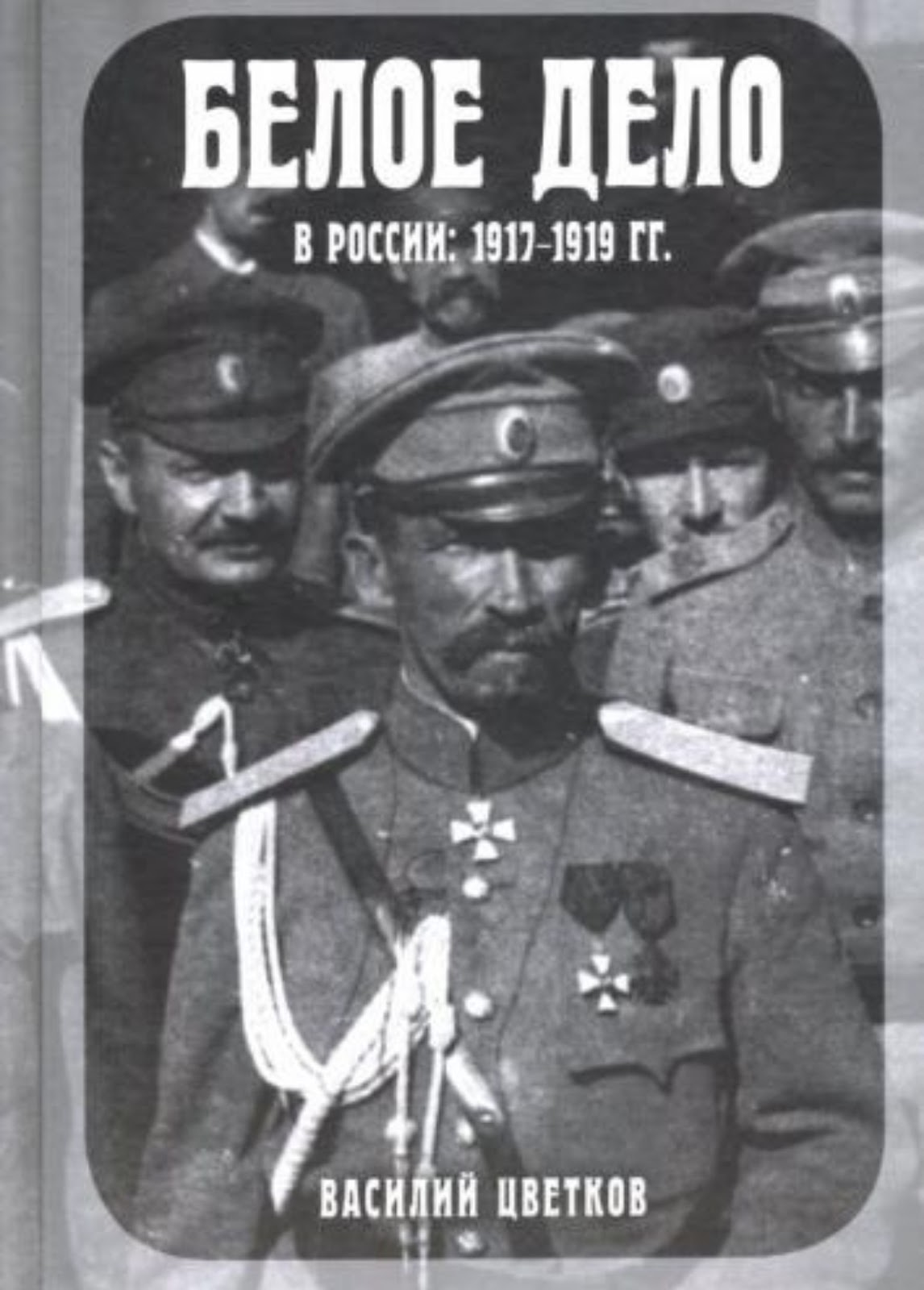
Conversation with the historian Vasily Tsvetkov: Whites in the Russian Civil War

A hundred years ago civil war raged in Russia, the Reds fought against the Whites. We talked with Vasily Zanikov , a professor at the Moscow State Pedagogical University, about what the White movement was: who they were white, what they wanted, why they were called that, what was their attitude towards religion in general and Orthodoxy in particular.


Ataman of the Great Don Don Afrika Petrovich Bogayevsky
  - Why are whites called white exactly?
- In 1917 and even earlier, in the period of the first Russian revolution, white color was perceived in the political spectrum as the color of legitimism and was associated with the monarchy. This was partly due to the history of France, where the royal emblem of the Bourbons was white lily, and the white color during the Great French Revolution became the color of the French royalists.
- That is, this term comes from France, and they used to designate supporters of the “old regime”?
- Mostly yes. And in Russia, the negative context of this epithet, emanating from the left, revolutionary journalism, was often used. But the participants of the White movement did not see anything wrong in this color. On the contrary, they thought that they could be proud of. But there is an important detail. When the civil war in Russia was going on, the term “White movement” was almost never used by the “whites” themselves. But in Soviet journalism it was used quite widely.
Whites considered themselves to be representatives and advocates of the legitimate Russian authorities.
"White" identified themselves as representatives and defenders of the legitimate Russian authorities. For example, the Supreme Ruler of Russia, Admiral Kolchak. He was not called the Supreme ruler of the White movement. Or the name of the region in which the military and political structures were located was used. For example, the Ruler of the South of Russia, General Wrangel in 1920. Denikin commanded the Armed Forces of southern Russia. And the last white government in Russia - the Amur region of the Zemsky Krai in the Far East - headed General Diterikhs as ruler. That is, here the decisive role in the title had a regional aspect.
In foreign countries, everything was different. The participants of the White movement began to define themselves as “white” more from a psychological, sociocultural position, and not from a military-political and territorial one. And it was very important. Because they were in a foreign land, in another country. We had to save ourselves not just as Russian people, but as supporters of a certain value system, for which they gave their lives during the civil war. And the definition of "white", this "color component" became relevant here.
There are a few more interpretations of the “white” context. White is the color of moral, spiritual purity. Remember: white clothes, white robes, white, light angels. In the physical sense, white is the spectrum of colors. And therefore, under the "white" could be summarized a variety of political, military forces that represented the opponents of the Bolsheviks in the broad sense of the word.
But still, in the context of a hundred years old word usage, this combination was used primarily by the Whites' opponents, the Bolsheviks, as an analogue of the reaction and restoration of the monarchy.
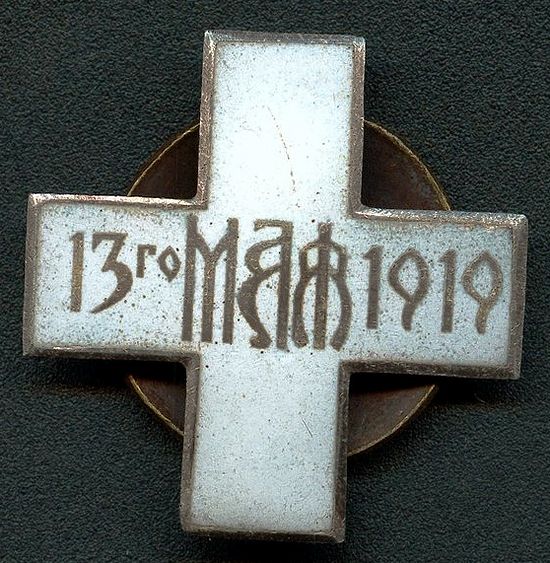
There is an inscription on the top of white gold lines (39 mm), May 13, 1919  


Premium gilded white enamel cross with identical sides (39 mm), along both sides of which there is an inscription in golden Slavonic script: May 13, 1919


True, the word "white" was used during the civil war in the North-West to refer to the fighters of the North-Western Army Yudenich. One of the tanks that participated in the “march to Petrograd” was, for example, called the “White Soldier”. The white cross of the north-westerners was sewn on the left sleeve of the overcoat or jacket. This can be explained by the fact that Yudenich’s army was considered a kind of analogue of the “White Guard”, which was in Finland and fought with the Finnish “Red Guard” in 1918. There was another interpretation: “Baltic Cross”, equally-terminal, white.

The phrase "white guard" was used during the Moscow battles of 1917, but only to refer to irregular military units. They were not junkers, officers or cadets, but high-school students, students and female students, officials. It was a "civilian" youth, speaking out against the Bolsheviks. Looks like a militia.

But rarely where else in the political context did the adjective “white” be used. When this term is simply called all those who spoke out against the Bolsheviks, there is a very large proportion of conventionality and schematism in it. This greatly simplifies the picture of the then confrontation.

- I would venture to say that, in principle, it is clear why whites have little called themselves white. After all, the red color is more vivid, energetic, warlike. And the white color is a bit out of this world. And calling yourself white is like putting yourself in a losing position energetically.

- You're right. I should add that we must also understand the following. When there was a civil war on the territory of Russia, the White movement assumed itself as a real alternative to Soviet Russia, the power of the Bolsheviks. And this alternative should have the appropriate name. And not psychological, metaphysical, but quite concrete: the legitimate Russian government.

Five signs of White movement

- What united those whom we call white? Was it anyway a single movement, or did it consist of completely dissimilar forces?

“When I was working on my doctoral thesis, and even earlier, in the late 1990s, when I wrote articles to Questions History and the Great Russian Encyclopedia (White Movement), I tried to identify five distinctive features.

The first is an irreconcilable standoff with the Soviet authorities. After all, if we are talking, for example, about Mensheviks and Socialist-Revolutionaries, then they are against the Bolsheviks, but under certain conditions. Sometimes they even made alliances with them. In particular, when the Left Social Revolutionaries joined the Council of People's Commissars in November 1917, or when they, together with the Bolsheviks, opposed Kolchak and raised revolts in Siberia.

Whites were always against the Bolsheviks and never compromised with them during the civil war.

- That is, the Social Revolutionaries and Mensheviks do not fall into the whites?

- They rather fall under the definition of "anti-Bolshevik forces" or "anti-Bolshevik movement." The terms "counter-revolution" and "anti-Bolshevik movement" are much broader than the concept of "white". The fact that they were all called "white", "enemies of the people", it largely went from V.I. Lenin. For him, everyone who is not with the Bolsheviks, or "fellow travelers", or "enemies". How easier to call them? All have become “white”, “counter-revolutionaries”, although this is a strong simplification.

The second sign, also very important, is the priority of military power, military dictatorship. These whites also differed from anti-Bolsheviks in general. Because for the anti-Bolshevik-socialists military dictatorship was unacceptable. Take the position of Kerensky in 1917, when he did not agree on an alliance with Kornilov. We see the same thing in 1918 in the Ufa directory, which was replaced by Kolchak. There were Democrats, anti-Bolsheviks, but not supporters of the military dictatorship. They were supporters of collegial power, a broad coalition of all those against the Bolsheviks, including the military.


Whites recognized the superiority of one-man rule, dictatorship personified as a military leader.

And whites clearly recognized the superiority of one-man rule, a dictatorship personified as a military leader. It could be Kornilov, Wrangel, Yudenich, Denikin, Kolchak. Why is it important? Because there is a war. And since there is a war, then there must be a priority of military authority over civilian.

But here I want to make an important clarification. Now completely wrong conclusions are often made that since White had a military dictatorship, it means that it was an analogue of the fascist regimes. The thesis of the supposedly "total dependence" of whites from foreign states is given. And then on these completely contrived grounds are made statements about the identity of Kolchak, General Vlasov, or, for example, Franco or Pinochet regimes. But in Chile there was no civil war, except for the battles in Santiago. Franco, having won the Spanish Civil War, remained a dictator. Vlasov never proclaimed his continuity from the White movement. And White’s position was as follows: a military dictatorship is needed only for a period of military actions. As soon as the war ends, the military should, conditionally speaking, “step aside”, ensure the elections to the National Assembly, give way to politicians.


But military dictatorship is only necessary for the period of hostilities.

And here we come to another distinctive feature of the concept of "white." It can be defined as the all-Russian scale of the political program. This was expressed in the recognition of Kolchak the Supreme ruler of Russia. He appointed Yudenich and Miller as his subordinates. Denikin also recognized him, becoming his deputy. And even then, when the whites found themselves on the “last inch of the Russian land” (as Wrangel called Crimea), they still continued to proclaim the All-Russian character of their power. Not now, in the future.


And the proclaimed All-Russian status made inevitable the centripetal nature of the military operations of the White armies. Were planned and carried out a "campaign against Moscow" and "a campaign against Petrograd." Both Wrangel, Dieterichs, and Baron Ungern spoke about the march to the “heart of Russia”, although their position was very far geographically from the central provinces.

The fourth line is the commonality of the proclaimed political programs. It is sometimes said that the military dictatorship made any political programs unnecessary. Say, the military - people are limited, only know how to command. But, first, it is unfair to the then military. These were people with a broad outlook and a large amount of knowledge. Let us recall at least Kolchak, who was a prominent polar scientist, or Denikin, a famous writer and public figure.


Next to the generals were politicians: the Cadets — the “warring party” in those years.

Next to the generals were politicians. Among them, the cadet party should be particularly noted. The Cadets, like the Bolsheviks, were the “belligerent party” in those years. The Cadet intelligentsia worked in almost all white governments, in the white underground. Many died. This party was almost immediately after the Bolsheviks came to power, banned, declared the party "enemies of the people." And in this situation, they had to get close to the military. They gave them political support and slogans. Whites have all the programmatic issues, if we look closely: agricultural, worker, national — everywhere we will find a strong Cadet influence.

The Cadets in many ways created the commonality of the White movement. And although the white fronts had almost no territorial contact (they came from different places: from Siberia, from the North, North-West, and South), but there was a common ideological, spiritual community.

And the fifth sign: whites almost always used Russian national symbolism as state. These were our white-blue-red tricolor and double-headed eagle. True, the variations of the double-headed eagle could be different: it could have been without crowns, under an Orthodox cross, with a sword, with outspread wings, with wings lowered ... But still, this symbolism remained common: the double-headed eagle and tricolor.

The anniversary of the February Revolution was a holiday in Soviet Russia

- What other significant political factions were among the whites, except for the cadets? How were the monarchists represented? There is a widespread opinion that there were few monarchists in the white movement.

- This is not true. I agree that among the ministers of the white governments there were few former ministers of the Imperial government, the white leadership did not include the bright leaders of the Union of the Russian People or the Union of Michael the Archangel. For some reason, it is believed that these two organizations were 100% monarchists. However, there is evidence, and not a single one, that many ordinary members of the Union of the Russian people even found themselves in the Bolshevik Party. Many, alas, lived on the principle of "where the wind blows." Previously, the Emperor was supported, and the Bolsheviks became profitable - they went to them. V.I. Lenin, when he declared that many old bureaucrats and officials had penetrated into the Bolshevik party and that the party had to be cleansed of such "members." And I think Lenin was absolutely right. Such "members" will not give any party strength. This is a party "ballast", not a real force.

As for the Cadets, it should be noted that they very quickly evolved to the right. By the end of 1917, many people declared the restoration of the monarchy and renounced their republican, "post-February" views. Many Cadets again spoke about the advantages of a constitutional monarchy or proclaimed a “non-denial” position. The implication was that the White movement did not determine the form of government - a monarchy or a republic. This will make a new, elected National Assembly.

Diterikhs proclaimed the restoration of the monarchy through the All-Russian Zemsky Sobor, through the period of military dictatorship. The only question that could not be answered was the question of the person: who will be the monarch. Many did not believe in the death of Nicholas II, Mikhail Alexandrovich and Alexei Nikolaevich. After all, their bodies were not found.

In the white press, for example, February 1917 cursed without embarrassment. Only the Social Revolutionaries and Mensheviks were proud of him, as were the Bolsheviks. This, too, must be remembered. The anniversary of the February Revolution was a holiday in Soviet Russia, it was celebrated every year as a celebration of the “Overthrow of the autocracy”.

Or take another vivid example: the composition of the guards regiments of whites. Not Markovtsev or Kornilov’s - it was the so-called “young guard”, but those regiments of the Imperial Guard, whose revival Denikin approved in southern Russia. If you take the "White movement" biographical reference book of historian S.V. Volkova, we will find in it representatives of almost all of our noble families. There and Obolensky, and Golitsyn, and Trubetskoy, and other famous noble families. Together with Denikin they went to Moscow. How then to say that the monarchists did not participate in the White movement? And where were they? In emigration immediately left? Many have not had much money after all the “confiscations”. Or "shoe polish cooked," as Colonel Tetykin in "Walking around the agony"? Of course, participated in the White movement. In this sense, Lenin was again right when he defined many whites as monarchists. On all Soviet leaflets and posters, whites were presented as bearing the restoration of the “tsarist regime.” This was a grain of truth.

- So, you agree with the opinion that if White won, the monarchy would be restored?

- With a very high probability. The monarchy was not excluded as a final decision for the future National Assembly. Especially considering that the Bolsheviks, anarchists and leftist Socialist-Revolutionaries would not have the right to participate in the elections.


The National Assembly was supposed to restore the monarchy - a constitutional

Another thing, what monarchy? Of course, this would not have been autocracy, but a monarchy constitutional, with parliament. But this parliament could “get better”.

- What do you think, what white armies had chances to win?

- Purely theoretically, those who were closer to our three, relatively speaking, capitals, had a chance to win. Kiev took Denikin, his army approached Moscow, and officers of Yudenich’s army, as is known, saw the dome of St. Isaac’s Cathedral in Petrograd. Since they recognized Kolchak, the admiral reasonably believed that they were performing a common cause. True, he himself from Siberia could not help in any way, if only he pulled over part of the forces of the Red Army. But if Moscow and Petrograd were taken, he would become the complete Supreme Ruler. And then it was supposed to convene a new National Constituent Assembly, which would take major decisions on the political and economic structure of Russia.

But in the warfare, whites had another problem. It's one thing to get as close to the capitals as possible, and another thing to take them and hold there. There was a risk of simply dying on the outskirts or during street battles. With high probability it could be assumed in relation to the small North-Western army. Under the leadership of the head of the Petersburg City Party Committee G.Ye. Zinoviev and LD Trotsky on the streets of Petrograd created several lines of defense, built pillboxes, put armor towers, built systems of cross machine-gun fire, etc.


By the autumn of 1919, the Red Army was already well formed and strengthened, including ideologically

We must not forget that by the autumn of 1919 the Red Army had been fairly well mobilized and concentrated. The shelves had a “communist frame”. In September-October 1919, mass party mobilizations were held. Lenin was not going to "flee" from Moscow. He was sure, and Trotsky, Stalin and many military experts convinced him that even if they temporarily had to retreat, White would still not be able to win the final military victory.

- So it would be a Pyrrhic victory?

- Yes.It would have been a big loss win. It is noteworthy that the whites themselves believed that they were closest to victory in the autumn of 1919. But Lenin believed that the opponents of the Soviet regime had more chances in 1918. The Red Army was then still weak, the red rear was also weak. Lenin feared more intervention than the whites, believed that a tenth of the Entente's armies in early 1919 would be enough to destroy the Soviet power. And by the end of 1919, there were almost 1.5 million people in the Red Army, and whites had half a million at best. Already from this alone we can conclude that it was very difficult for them to achieve a complete, final victory.

It was considered, however, another version of the mass surrender of Red Army soldiers under the blows of Denikin and Yudenich, an option in which the Red Army falls apart, despite its large number. But the Red Army at that time was strengthened by the commissars, the party composition was strengthened. Therefore, hoping that it would simply fall apart so simply was not very realistic.

- And who was more cruel to the civilian - white or red? Or was cruelty shown equally?

- There is an opinion that was substantiated, in particular, in the work of P. Sorokin “The Sociology of Revolution” in the works of other sociologists who compared our revolution with foreign analogues: the more agrarian a country has, the more violent the civil war becomes. And vice versa. By the beginning of our civil war, cruelty had become the norm. The value of human life has fallen. This happened since the First World War. Murder is no longer considered a mortal sin. Justified by the fact that for the sake of "higher purpose" you can kill, commit a mortal sin, and nothing special will happen. Add to this hundreds and thousands of rifles, revolvers, machine guns, which were in the hands of the population after the spontaneous "demobilization" of the tsarist army. This is also an important factor.


nother important aspect is the degree of central authority control over local authorities. For example, Ya.M. Sverdlov actively supported the policy of “red terror”, disclosure. But he was the author of dozens of directives, which talked about the arbitrariness of local security officers. Sverdlov turned to Dzerzhinsky, and he also tried to fight it. And the local Cheka, in particular Kiev or the infamous Kharkov, created everything they wanted. The Ural Regional Council independently made a decision on the execution of the Tsar Family. Gave Sverdlov this written instruction or did not, they were not particularly interested.

The same with whites. The central government had little leverage over local chieftains, for example. Kolchak issued repeated orders about the need to restore the legal system, introduced prosecutorial oversight. But who kept all these directives? The local chieftain, the local counterintelligence, using the law on martial law, carried out repression.


The most brutal was the "green" terror - the mayhem of rebel groups and armies

I would also add terror by the rebels, the so-called. "Green". He was probably the most brutal. Worse than white and red, because whites and reds sought to create rule of law. And the rebels, by definition, had no legitimacy. Lawlessness, in the language of the 90s of the last century. How dad decides, so do. At the same time, the cartridges were saved, could have been buried alive in the ground, stabbed, crucified, stabbed with forks.

- A white terror, then, too?

- There was no legal concept of “white terror” then. I can conditionally call the “white terror” a system of repressive measures that were applied by white governments, including in the conditions of declaration of martial law. In relation to the rank and file members of the Bolshevik Party, a multi-year exile was suggested. The death penalty was allowed only to the party leadership.

“Can we then say that the white terror was less cruel than the red one, or not?”

- We do not know the exact extent of terror. The question of who killed how many is a question of the degree of licentiousness of the local bodies that dealt with this terror. An example is the Crimea, where the exact death toll is still unknown with the sanction of R. Zemlyachka and Bela Kun. It is noteworthy that they were convicted in the All-Russian Central Executive Committee of the Soviets. In the summer of 1921, a commission of the All-Russian Central Executive Committee arrived in the Crimea and stated that arbitrariness and impunity of the Cheka’s organs were going on there. True, it was too late.

The weakness of the central government is one of the features of any revolution. On the one hand, the government wants to strengthen, trying to position itself as a government that is reckoned with. But she lacks real opportunities to do this, because the device is disassembled, the “drive belts” do not work. The center gives a general guideline. And on the ground, this directive is brought to the point of absurdity or to the direct opposite of what was decided in the center.

- What role in civil played a national or, as it was sometimes said then, non-ethnic factor?

- For the Reds, he did not play the main role, because for them the notion of “foreigner” was a relic of tsarism. They considered it important to encourage the nomination of people to leadership positions not from the titular nation, be it in the Caucasus, Turkestan, Ukraine, etc.

Whites considered it important to rely on the local, national elite, the local nobility: princes, pans, emirs, etc. It was believed that they can enter into contracts, to cooperate. Lenin was also right here in principle when he said that “the exploiters without distinction of nationalities” united against the Soviet power. But if the local elite was categorically separatist, then the whites, speaking from the standpoint of the revival of "United, indivisible Russia", did not succeed with them.

- Can we say that this war was fratricidal? In Denikin's memoirs there is an episode when his army storms a city, and the Reds fight it off fiercely and skillfully. And one white officer says to another officer: “Well, what do you want, there Russians are fighting”. And then they fell silent, kneading the topic.

- Yes of course. Any civil war is a fratricidal war.

“Sometimes they say that they are foreigners, the Jews have seduced our people.” In the red were mostly the same Russian?

- It was a fratricidal war: brother to brother. Jews were in the red and white armies and authorities.
Vyoshenskaya uprising 

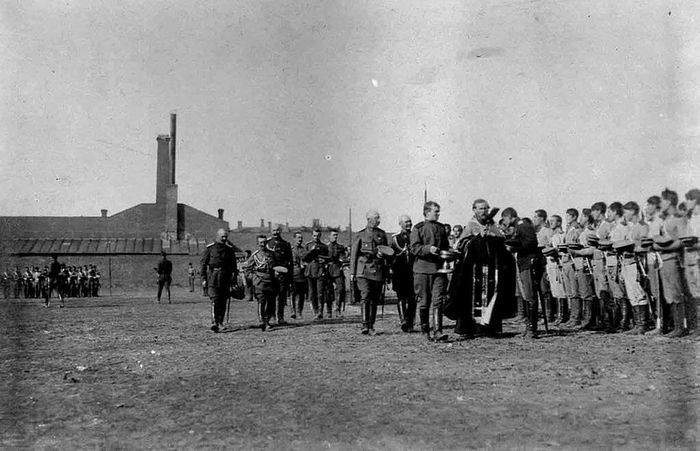
Don Army, 1918  Prayer of the Ataman regiment  


Don Army, 1918 Prayer of the Ataman regiment

I would like to note one more thing: when working on materials about terror during the civil war, I encountered the facts, especially among the so-called. "Green terror", about the killings of Orthodox priests. Many of them need additional study, and perhaps we will witness a new canonization.

In general, the history of the White movement is far from complete.

Source

Read more »

28/3/19

The first congress of the Union of Cossack Youth was held in Krasnodar


The event on March 27th was attended by the head of the region Veniamin Kondratyev, Deputy Minister of Education of the Russian Federation Irina Potekhina, Ataman of the Kuban Cossack Army Nikolay Doluda, vice-governors, representatives of the clergy, the region’s education sector.

The Union of Cossack Youth movement was created in 2017 and already brings together about 95 thousand people - students of cadet corps, schools, Cossack sports clubs, students. The guys help veterans, assist in orphanages and nursing homes, care for monuments and graves of heroes.

“You can share how you can work together, preserve traditions and Cossack culture — there are no such active friendly Cossacks anywhere in the country,” said the deputy head of department.

According to the vice-governor, ataman of the KKV, Nikolai Douda, special attention is paid to the support of the Cossack education. In the Cossack classes today trained 82 thousand children. Another thousand - in the cadet corps.

“In the Leningrad region we have continuity in the Cossack education system: Cossack kindergarten, school and Cossack groups at the Leningrad Social Pedagogical College, where students study as teachers of Cossack classes,” the deputy head of the region said.

Various mass events with the participation of Cossack youth take place in the region. For example, last year the Cossack dictation was organized for the first time. About 22 thousand people tested their knowledge of the history, traditions and customs of the Kuban Cossacks.

400 atamans of Cossack classes, Cossack schools, Cossack cadet corps took part in the change of the “Kuban Cossacks” youth forum “Region 93”.


Source

Read more »

25/3/19

Kuban Grand Council of Atamans


The Council on March 25th was attended by Metropolitan Yekaterinodar and Kuban Isidor, representatives of the administration and the Legislative Assembly of the region, law enforcement agencies, deputy heads of municipalities, directors of the Cossack cadet corps, journalists.

As noted by the Ataman of the Kuban Host, General Nikolai Dolud, today the Kuban Cossack Army numbers almost 55,000 Cossacks. Given that there are about 250,000 people in the registered Cossacks of the country, the Kuban Army is the most numerous in Russia. And it was the Kuban Cossacks, being a Cossack vanguard, who first came to the aid of the inhabitants of the Crimea five years ago at a difficult moment, when the historical events of the Crimean spring occurred.

“The Cossack’s blood has a sense of responsibility for the country, for the Fatherland,” Nikolai Doluda noted. - The Cossack's blood is a willingness to help a person, or a republic, or a country in distress. Patriotism, Homeland - are not empty words for the Cossack. It was from time immemorial and passed on to the gene level, with mother's milk, from generation to generation. And you, the Kuban Cossacks, are real heroes. And our participation in the events of five years ago is a real military campaign of the Kuban Cossack army".

As noted by the Cossack general, the Union of Cossack youth of Kuban already has more than 95,000 people. 4,500 Cossack classes were created in the region, 53 Cossack schools work, and about 7–8 Cossack kindergartens.

And the task that the chieftain sets is to create a system for educating the younger generation in such a way that it starts in kindergarten, goes through all school years and ends in secondary special and higher educational institutions, when a person enters a larger life with a Cossack mentality Cossacks, knowing the history, culture and traditions of the Kuban Cossacks.


 Николай Долуда

Read more »

10/3/19

Kolchak's grandson died


The grandson of Admiral Alexander Kolchak died. This was announced by the Union of the Descendants of Gallipoli on Facebook. Kolchak was 85 years old. He died on March 9th in Paris after a long illness. The exact cause of death is not called.

Alexander Rostislavovich Kolchak was born in 1933 in France. He studied at the Christian College in Meudon. He served in the French army in Algeria 1954-1956. He was a teacher of foreign languages. He studied at the Sorbonne and was a jazz musician. His grandfather, Admiral Alexander V. Kolchak, was the leader of the White movement during the Civil War. From November 1918 until his death, he was the Supreme Ruler of Russia. He was shot in 1920 in Irkutsk. His wife Sophia and her son Rostislav fled to Romania, and then to Paris.

Read more »

7/3/19

El Tsarévitx Jordi visita Moscou

El Tsarévitx Jordi, Georgy Mikhailovich, va felicitar el metropolità Istra Arseny amb el seu aniversari. El Gran Duc va arribar a Moscou el 3 de març de 2019 en una visita de treball. Va visitar l'Església de Sant Martí l'Confessor i va participar a l'oració d'acció de gràcies, que va ser realitzada pel Primer Vicari del Patriarca de Moscou i tota la Rússia, Metropolità Istra Arseny. SAR es va reunir amb els alts càrrecs de l'església ortodoxa moscovita i després va participar en una recepció festiva.


Read more »

28/2/19

All-Russian Monarchist Center 30-year service to the Monarchical Idea in modern Russia.


The Winter Imperial Ball was held in Kolomenskoye in February 9th- dedicated to the 30th anniversary of the beginning of the monarchical activity - Chairman of the All-Russian Monarchist Center (Председателя Всероссийского Монархического Центра), Director of the Moscow Memorial Museum of the Russian Imperial Surname Nikolai Nikolayevich Lukyanov-Razumovsky. Veterans of the Monarchist Movement, leaders of friendly imperial social organizations were invited to the celebration. Among them were the Head of the Military Orthodox Mission (VPM), Counselor to the First Hierarch of the ROCOR Igor Smykov, President of the Moscow Aristocratic Club, Count Alexei Kamensky, Duke of Friulsky, Chairman of the Russian Alexander Imperial Committee Viktor Balyshev, member of the Council of the International Union of Nobility Nikolai Pokrovsky, famous historian Associate Professor of the RSGU, candidate Historical Sciences Evgeny Pchelov.

The Chairman of the VIC Nikolai Lukyanov-Razumovsky addressed the audience with a greeting - he briefly recalled the circumstances of the events of the early spring of 1989 - when he was still a police officer with colleagues, he organized a point on the Izmaylovo vernissage on the distribution of monarchical and Orthodox literature, as well as portraits of the Royal Family. It was there that the main core of the staff was formed - which were first organized as a Department of the Russian Imperial Union-Order. and later, when such an opportunity appeared, and they registered the Monarchic Center and the Museum of the Imperial Surname.

The VIC - presented I.Trushkin and S.Vasilyev, two volunteers of the Youth Association “Russian Traditions” for his great personal contribution and active participation preservation and popularization of the best traditions of Russian and European culture.


Read more »

24/2/19

El Comitè Nació i Llibertat a les manifestacions contra Putin

El Komitet Natsiia i Svoboda (KNS) va participar a les marxes del 24 de febrer a vuit ciutats russes. Denunciaven el terror polític i la cortina de ferro del règim de Putin en l'aniversari de l'assassinat de l'opositor Boris Nemtsov. Els assassinats de l'oposició, els defensors de drets humans i els periodistes periodísticament compromesos per part del Kremlin, van ser denunicats així com es va cridar l'atenció pública sobre el problema del possible aïllament de la Federació Russa des de l'Internet internacional (actualment s'està considerant la llei corresponent a la Duma). Al costat del KNS va marxar l'Associació de Resistència Popular amb les seves banderes negre-verdes. Ambdós grups s'oposen la guerra del Donbass. KNS és l'ala moderada del moviment Russkie (Russos) i va néixer el 2014.


Read more »

23/2/19

The 100th anniversary of the Kuban flag was celebrated in Krasnodar

The solemn event dedicated to the celebration of the 100th anniversary of the Kuban flag was held on Defender of the Fatherland Day, February 23, on the Theater Square of the regional center. The governor of the region, Veniamin Kondratiev, took part in it.

The flag of the Krasnodar Territory, measuring 10 by 15 meters, was brought to the square by the Cossacks of the Guard of the Kuban Cossack Army. During the flag raising, the Kuban anthem was played by a brass band.


Read more »

22/2/19

Glazov estudia la proposta dels cosacs d'un monument al Tsar Alexandre II i als Exèrcits Blancs

A la fi de maig de 1919, els Exèrcits Blancs  encapçalats per Anatoly Pepeliaev van llançar una ofensiva contra Vyatka i el 2 de juny de 1919 va prendre Glazov, derrotant a l'Exèrcit Roig. En honor del centenari d'aquest esdeveniment, es proposa crear d'un "Carrer de la Reconciliació" plantant arbusts de lila blanca i vermella prop del monument als herois de la guerra civil. Els cosacs locals membres de la UROO "Prikamsky Cossack Division" i el club d'història local de la ciutat de Glazov proposen restaurar el monument al Tsar Alexandre II. Els historiadors locals consideren que és injust que la memòria dels morts dels homes de l'Exèrcit Roig quedi immortalitzada, però no als Guàrdies Blancs. També van proposar restaurar el monument al Tsar, instal·lat a Glazov en honor del 300 aniversari de la dinastia Romanov

El 19 de febrer, aquest recurs va ser considerat pels membres del Comitè Permanent de la Duma de Glazov.
Antic monument al Tsar Alexandre II que seria restaurat

Read more »

19/2/19

A memorial plaque to Kolchak installed in Omsk


A memorial plaque of Admiral Kolchak appeared today on the building of the Military Commissariat in the Central and Soviet administrative districts. The inscription on it reads:

"In this building in October-December 1918, Admiral A. V. Kolchak lived."

Apparently, we are talking about the project "Third Capital", supported by the Minister of Culture of the Russian Federation Vladimir Medinsky, under which such signs are installed on buildings associated with the activities of the Russian government in Omsk in 1918-1919.

It is interesting that at the end of the building of the military registration and enlistment office there is another plaque that says that Red Army soldiers were leaving the building during the war years for the front. Therefore, the “neighborhood” of two characters turned out to be somewhat ambiguous. There is a question about the coordination of the “Kolchak” plank - after all, the building on Pushkin, 74, has the status of an architectural monument and nothing can be hung there without special permission. The military enlistment office is also a kind of national monument: the brick walls are dotted with inscriptions that have been left for draftees for decades.

Note, the perpetuation of the memory of the admiral often becomes a cause for scandal - the Communists and various social movements invariably oppose this, for example, The Essence of Time. A monument to Kolchak never appeared in Omsk, although it was made and delivered to the city. In St. Petersburg, a memorial plaque was doused with paint, and then the court decided to dismantle it in connection with the fact that Kolchak is still officially a war criminal after a court sentence of 1920. This decision was repeatedly appealed, but in 1999 the Trans-Baikal Military Court confirmed its legality. In 2017 years ago, a resident of Irkutsk filed a lawsuit in the Omsk Regional Court, demanding the rehabilitation of members of the Kolchak government, but did not succeed.
 

Read more »

13/2/19

In Dnepropetrovsk, a procession in honor of Tsar-Martyr Nicholas II


In Dnepropetrovsk, the Orthodox celebrated the anniversary of the arrival of the last Russian Tsar Nicholas II in the city. "On February 13, along the central avenue of the Dnieper, a column of Orthodox Orthodox of the Moscow Patriarchate passed, which thus marked the anniversary of the arrival of the Russian Tsar in Yekaterinoslav," the report says.

Believers and parishioners were convoyed along the central avenue of the city on February 13, on Wednesday. The situation was not spared by the Ukrainian media. The local newspaper commented on the situation in a publication dedicated to the move.

“The Moscovites organized their“ procession ”right in the center of the city, at one time one of the first to defend Ukraine against the“ Russian world ”. The churchmen walked along Yavornitsky Avenue from the railway station to Cathedral Square, where they already held a service “for the king and the Fatherland,” inside the Spaso-Preobrazhensky Cathedral, the journalists wrote.


At the same time, journalists remind their readers that Nicholas II is canonized "both in the Russian Orthodox Church and in the ROCOR." Hence the surprisingly profound conclusion of the Ukrainian masters of the pen: “That is, these individuals openly advocate the holy Muscovite“ martyr-hero ”, whose ancestors destroyed Ukrainian culture and statehood for several centuries.


Read more »

4/2/19

Meeting of Russian nationalists with monarchists

The meeting of the Great Russia (Великая Россия) party and the participants of the Monarchist Movement of Russia (Монархического движения России) on February 4th was devoted to the problems of interaction with other organizations and the joint preparation of the rally, which is scheduled for February 23 and will be devoted to the protection of the territorial integrity of Russia, as well as the anniversary of the Ice Campaign (101 years). The meeting left a dual impression.

People who are not indifferent to some topics react quite violently, but some kind of balanced approach sometimes escapes, and we lose the topic for which we have gathered. The first question for monarchists who cannot have any other faith than Orthodoxy is the question of an acceptable degree of participation in politics and the very goals that an Orthodox person can pursue in political processes. One of the destructive (in my opinion) approaches is an attempt to evade political issues in general, declaring that we "do not follow the advice of the wicked." One of the participants in the meeting reasonably remarked that Christ did not shy away from preaching to sinners. Another format of “escapism” is references to various kinds of prophecy, even recommending to expect the rebellion of the relics of Seraphim of Sarov, which should be turned into a living old man, pointing us to the king. Here I have already responded violently, although it was impossible to explain on this topic in the conditions of the meeting. I believe that prophecies should always be treated with caution, including their interpretations. Many of the prophecies and the words of holy people are in fact just apocrypha. The Resurrection in the flesh, as we remember, must happen at the end of time. Lazarus was resurrected by Christ, but still not from the relics. And, it seems, no one can boast of knowing a case where the relics would become living flesh. In addition, the hope for such a revival (as one of the participants of the meeting reasonably told me in a private conversation) is too similar to the expectation of Moshiach, who will appear and solve all the problems of our people, pointing us to the king.

The king is already assigned to us by the oath of cattle of 1613 and the laws of the Russian Empire. The question is only in the consideration by the Zemsky Sobor of legal arguments in favor of one candidate or another and of weighing all the objections before making a decision on calling to the Throne. The second question is how far can the compromises that monarchists can go to, by participating in the common cause of all Russian people for the salvation of Russia and the expulsion of the invaders? Here discord creates serious obstacles. Personal grievances, unwillingness to forgive unreasoned words regarding the future of the monarchy lead directly to an absurd sect, which may create some kind of smoothed historical reconstruction, but will in no way take part in preserving Russia and creating conditions when people understand that the best and only acceptable is the monarchical form of government. An attempt to determine the non-monarchical part of the "right" spectrum as accomplices of the communists is an extremely destructive position. Accomplicers are just those who are trying to mark people who are close in their outlook on the world with alien symbols. It destroys all cooperation.

Meanwhile, in the political spectrum of monarchists, natural allies are Russian nationalists and national patriots. As long as those and others do not mix with the “red ones” and do not slander themselves with their symbolism and rhetoric, cooperation is possible and necessary. The correct decision was the “Great Russia” and the NPSR movement not to participate in the “red” rally, supposedly dedicated to the protection of the Kuriles. Meanwhile, some monarchists at this rally, filled with portraits of Lenin-Stalin and other satanic symbols, nevertheless came. After this, it seems strange to repeat false information that our party and other organizations represented at the national-patriotic meeting allegedly cooperated with the communists in the elections by participating in the company of Pavel Grudinin . The company participated, but did not cooperate with the Communists. At least, I vouch for the party “Great Russia”: we did not cooperate with the Communists, and they too did not cooperate with us. A couple of times we met with representatives of the leadership of the Communist Party at technical meetings. And the intention of this organization to blot the election with “red paint” we perceived as a direct task of their supervisors - the KREMLYADI. This was the reason that Grudinin was not released to the second round. We have always considered and continue to consider the Communist Party of the Russian Federation traitors, and those who call themselves Communists and slander historical Russia are ordinary Russophobes. With them, of course, there can be no cooperation. The same applies to liberal-Western groups, as well as organizations serving the interests of the invaders. For our party, a priority would undoubtedly be an alliance with the organizations of Russian nationalists. But now there are no such people, since the project of the URN (managed by Russian nationalism ) implemented by the Kremlin has brought some to prison, others to the ukrobanderovschiny and passionate separatist Russophobia. We are waiting for the emergence of new Russian organizations and are ready to cooperate with them. Our national "patriots" are our natural "left" ally, and the NPSR is the closest and most understandable organization in which people continue their activities, with whom we have been organizing many meetings and conferences, as well as the annual Russian March , and all it is under the imperial banners, without any “redness” in words and symbols. Monarchists for us are natural allies "on the right." This cooperation is hampered by either direct betrayal and servicing of the invaders (first of all, talking about the pro-Putin, lackeys “Double-headed eagle”), or pride, shy of an educational mission in the “right” spectrum of society. At the meeting, we noted that the reproaches to the PDS NPSR can only be found to be insignificant to a small extent. The reproach that this non-monarchical organization is simply ridiculous. The Great Russia Party is also a non-monarchist organization. The reproach in the “red element” was partly true six months ago, but now, when the Communist Party’s treachery became obvious to many, “leftism” in the PDS NPSR began to fade - many previously “leftists” began to move to national positions. And this is a huge success of the leadership of the PDS NPSR, with which we are connected not only by a political union, but also by friendly relations. Of course, we were shaken and would be shaken, pulling out from our ranks those to whom “leftism” seems to be a convenient ally, behind whom, ostensibly, there is some sort of mass character. This is an illusion. Russia has long been a “non-aligned” country, and Russophobia is only covered by “Left-wing”. Ideologically, communism (like socialism) is dead. There are not the slightest signs of creative thought. Zombies are left from him, repeating only memorized propaganda stamps from the “Glory to Labor!” Series. Pushing PDS NPSR away, monarchists risk being left out of business and dissolving the “right” flank in the leftist simulacrum sponsored by KREMLYADI. The third aspect is purely practical. We are going to discuss something vigorously, but not everyone who discusses is ready to do something together. Take help, of course, rarely who refuse. But to help and not think. Not to mention the integration of many weak and heterogeneous projects into something holistic. This time, we again only declared the need to participate in a common cause - in preparing the upcoming rally. But those who offered to do something specifically and personally invest their strength, it turned out ... alone. And even the payment for the room where we had a meeting, which we always collected from school, this time had to be scraped up in our pockets. Apparently, the majority of participants decided that we have some sources of funding that cater for the desire of those who have gathered to talk in the spirit of "pique vests" and disperse without any obligations. It can be stated that so far our hopes that the formation of the Monarchist Movement of Russia (MDR), which took place this summer, did not materialize - a qualitative shift, activation, rallying of the monarchists, their return to political action did not happen. We are still at the level of discussions, which sometimes become a cause for discord. We came across not only the vagueness of orientations in the modern world for many of those who think that the Lord leads them in life, but also with the impossibility of simply agreeing on an even attitude to all Orthodox jurisdictions, among which there is no canonical continuity (including the Moscow Patriarchate). And here, instead of modesty and rationality, we also see the intention to establish a monopoly only of our jurisdiction, which comes not only from the priests, but from the laity who are trying to be holier than the Moscow Patriarch. Many of our "right" problems confirm that the idea in the "right" part of the political spectrum can only be Russian nationalism . The remaining ideological complexes are not thought out and cannot become a point of attraction for the Russian intellect and the Russian people as a whole. The social or national-state aspect of the worldview in Russian nationalism is shaped to the details, and therefore national patriots and monarchists, as the two wings of the pivotal direction, should focus on Russian nationalism . The Russian movement has no other way, Russia simply does not. Any other way is the collapse of statehood, the elimination of Russia and the Russians.


Andrey Savelyev
Great Russia 

Read more »

3/2/19

Celebrations dedicated to the memory of Cossack colonel Vasily Chernetsov, who died at the hands of the Bolsheviks, held on the Don


Russian Cossacks (Cossack Cadet Corps, The Great Don Army and Cossacks of the Great Don) recalled the tragic events of the beginning of the Civil War, the victims of which were the Cadets, Junker and the Monarchists, led by Colonel Vasily Mihailovich Chernetsov. The commemorations took place on February 1, 2019 in Novocherkassk, where a memorial service was held at the old cemetery, military honors were given and wreaths laid at the supposed burial place of the general from cavalry, elected Ataman of the Don Donskoy A.M. Kaledin. After a fraternal dinner, Cossack Cadet Corps was held a recital dedicated to the days of the memory of the tragic events on the Don.

On February 2nd, participants will gathered in the village of Kalitvenskaya in the Church of the Assumption of the Most Holy Theotokos, pray for those who were killed in 1918-1920. In the village of Glubokoy, the battle was reconstructed from the march at the railway crossing, after which all participants in the reconstruction gave military honors at the Poklonniy Cross at the site of the death of the detachment V.М. Chernetsov, and in the evening in the farm Volchenskoy held a memorial service in the Church of the Life-Giving Trinity and giving honors at the cadet burial of the partisans-Chernetsov.

On February 3, reenactors followed the Bolshoy Log – Kaplitsa route, after which, in the area of ​​the Monastyrsky Tract, participants reproduced the military-historical maneuvers of the battle. At the end of the reconstruction, a memorial service for the fallen partisans of the detachment of Colonel Vasily Chernetsov at the Pokrovsky military chapel at Monastyrsky.

“It is very important for us to remember the history,” said the director of the department for the affairs of the Cossacks S.N. Bodryakov. This year, more than 100 cadets, including 70 cadets and 20 teachers of Shakhty general Yakov Baklanov of the Cossack cadet corps, 20 cadets of the Second Don emperor Nicholas II of the Cossack cadet corps, 20 cadets of the Don Emperor Alexander III of the Cossack cadet corps, and also almost 50 members of military history clubs from Rostov-on-Don, Taganrog, Azov, Shakht, Tatsinskaya stanitsa, 13 Cossacks of cavalry platoons of the Great Don Army from Millerovo, Azov and Oktyabrsky districts were involved in the events.

With the death of a detachment of young Cossacks under the beginning of a young Colonel Vasily Mikhailovich Chernetsov, the Civil War began on Don. In an unequal battle, a partisan detachment from the cadets of the Don Emperor Alexander III of the Cossack cadet corps, students of Don cadets and real schools, gymnasium students formed to defend the Don, and revolutionary Cossack front-line soldiers, with which in January 1918 in large numbers accumulated on the junction railway Station Deep.

January 20 (February 3 in a new calendar) in 1918 after a bright victory at the stations of Zverevo and Likhaya, as well as the capture of Kamenskaya stanitsa V.M. Chernetsov was produced by the Ataman A.M. Kaledin at the rank of Cossack colonel. However, the 27-year-old commander incorrectly assessed not only the mood, but also the number of Glubokaya’s enemy who had accumulated at the station, which was led by military foreman N.M. Golubov. The battle for the station turned for the partisans a tragic defeat. Many of the cadets, once captured, were immediately executed with a rifle butt to the back of the head. The revolutionary-minded Cossacks did not even regret the girls who served as sisters of mercy in the detachment.

V.M. Chernetsov was wounded during the battle and captured by NM Golubov. Despite this, the surviving partisans continued their attack on Glubokaya station from Kamenskaya stanitsa. As a result of the actions of the partisans V.M. Chernetsov managed to escape from captivity and take refuge in the village of Kalitvinsk, where he was born and was baptized. There he exhausted from his wounds. Chernetsov was taken outside the village, where, according to some information, he was shot, according to others, F.G. Podtyolkov personally killed him with a sword. In the course of these events, for the first time since the October Revolution of 1917, the Cossacks came together in battle, brotherly blood was shed. The Don Civil War was began.

Read more »