
Chelyabinsk Conservatives rallied in honor of the birthday of the All-Russian Emperor Nicholas II on May 18th 2021.
Video link: https://youtu.be/wr4Yma5bLR8


On May 17, Moscow hosted the XI scientific-practical conference "Church and Cossacks: Collaboration for the good of the Fatherland." The conference was held within the framework of the XXIX international educational readings "Alexander Nevsky: West and East, the historical memory of the people."
The organizer was the Synodal Committee of the Russian Orthodox Church for Interaction with the Cossacks with the support of the Department of National Policy and Interregional Relations of Moscow. The event was attended by over 600 people from Russia, France, Belarus, Ukraine and the Czech Republic. Its main goals are the preservation, development and promotion of traditional cultural and historical traditions and spiritual and moral values of the Russian Cossacks, as well as the upbringing of the younger generation of Cossacks. The results of the fruitful work of the conference participants will be combined into a collection of reports, which is planned to be published and used in the further work of the Cossack and church organizations.


An appeal with a request to accept them into the structure of the Great Army of Don Russia was handed over by the Luhansk Cossacks to the Chairman of the Supreme Council of the public organization Union of Cossack Warriors of Russia and Abroad (SKVRiZ), Deputy of the State Duma of Russia Viktor Vodolatsky on May 12 during a round table in Luhansk.
Google.News IA Red Spring channel in Google News
“We live on the historical lands of the Great Don Host - this is our history, this is our blood. Only all together, united, we can win on our Russian Cossack land, especially since the war is not over yet, ”said Sergei Yurchenko, adviser to the head of the LPR on Cossacks, cadet education and military-patriotic education of youth.

May 6, 2021, on the feast of St. Great Martyr George the Victorious, H.I.V. The Sovereign Heir Tsarevich and Grand Duke Georgy Mikhailovich, together with his Bride Victoria Romanovna, prayed on the day of his Name Day in the Church of the Life-Giving Trinity in Orekhovo-Borisov.
The Grand Duke partook of the Holy Mysteries of Christ and took part in the procession with the icon of the Resurrection of Christ.
At the end of the service, His Imperial Highness presented the insignia of the Imperial Orders to the rector of the Church of the Life-Giving Trinity, Dean of the Danilovsky District, Archpriest Oleg Vorobyov (numbered to the Order of St. Anna) and hagiographer and patron of the arts A.V. Bugaevsky, whose earlier 75th birthday was celebrated on this day (elevated to the dignity of the Knight of the Imperial and Royal Order of St. Stanislav I degree). Also, the Grand Duke presented the Imperial medals to O.A. Koroleva-Pereleshina (medal of the Order of St. Anna) and V.A. Bugaevsky (hereditary medal "In memory of the 400th anniversary of the House of Romanov. 1613-2013").
In the evening of the same day, a reception was held in the building of the Soviet Peace Fund on Prechistenka in honor of the Name Day of the heir to the Head of the Russian Imperial House.
At the entrance to the building of the Grand Duke Georgy Mikhailovich Foundation, the bride of His Imperial Highness Victoria Romanovna and her father, His Excellency Ambassador Roberto Bettarini, were greeted by the First Vice-President of the Soviet Peace Foundation, Doctor of Law. S.N. Baburin and the ranks of the Chancellery of the Head of the Russian Imperial House.
Before the reception, the head of the Office of the Chancellery E.I.V. on historical and memorial activities, Hieromonk Nikon (Levachev-Belaventz), co-served by Deacon Alexy Kulikov, performed an Easter prayer service with the proclamation of the statutory many years of the royal order.
At the end of the service, His Imperial Highness presented the insignia of the Imperial Orders to one of the church leaders of the Life-Giving Trinity near the Saltykov Bridge N.V. Koryabkin, associate of the Movement For Faith and Fatherland, Count L.P. Komarovsky (elevated to the dignity of knights of the Imperial and Royal Orders of St. Anna, III degree), as well as the head of the press service of the Movement S.G. Pavlov (elevated to the dignity of the Chevalier of the Imperial and Royal Order of St. Stanislav III degree).
Then the director of the Chancellery of the Head of the Russian Imperial House A.N. Zakatov and S.N. Baburin.
The reception was attended by the first President of the Republic of South Ossetia E.D. Kokoity, Counselor for CIS Affairs of the Spanish Embassy in Russia Gonzalo Furner Conde, well-known public figures N.A. Narochnitskaya and A.P. Torshin, Major General V.V. Popov, A.V. Bugaevsky, associates of the All-Russian public movement "For Faith and Patronymic", headed by the Chairman of the Governing Center A.V. Kulemin, members of the Russian Nobility Assembly, headed by the First Vice-leader A.Yu. Korolev-Pereleshin, Chairman of the Societies of the Descendants of the Participants of the Patriotic War of 1812 and the First World War V.I. Alyavdin, President of the Diaghilev Center International Charitable Foundation N.G. Korzun, President of the Russian Middle East Society Foundation I.I. Spivak, secretary of the Moscow Union of Journalists V.I. Cheremukhin, Chairman of the Fund for the Memory of the Grand Duke Sergiy Alexandrovich D.B. Grishin, Chairman of the Russian-Georgian Friendship Society "Dzalisa" T.I. Jandieri, editor-in-chief of the newspaper "Spetsnaz of Russia" P.A. Evdokimov, editor-in-chief of the Internet edition "Good people" V.E. Yakobidze, full members of the Russian Academy of Arts P.T. Stronsky and A.A. Shilov, famous opera singer D.D. Davydova, saxophonist Nick Schaeffer and other members of the public.


Kerch honored the memory of all those who more than a hundred years ago were forced to leave their homeland as a result of the fratricidal war.

On April 25, 2021, within the framework of the Days of Remembrance dedicated to the centenary of the Russian Exodus , flowers were laid at the cross at the Kerch sea station, according to the official website of the Heritage Foundation .
The event was attended by the orchestra of the 115th separate special-purpose brigade of the Russian National Guard under the direction of Major Daniil Rafailov. The banner group of reenactors of the Drozdovsky regiment from St. Petersburg with an exact copy of the regimental banner stood guard at the cross. Representatives of the military-historical club "Rubezh" from Maikop and the Union of Societies "Heritage of the Empire" from the village of Otradnoye of the Krasnodar Territory, the Kerch-Yenikalsky khutor Cossack society of the Black Sea Cossack Host lined up nearby. Representatives of the Kerch community were also present at the laying of flowers.
The audience was addressed by the President of the Heritage NBF, Lieutenant General Leonid Reshetnikov, who thanked the representatives of the Black Sea Cossack army, Donets, Tertsy for their work on restoring the historical memory of millennial Russia.
“Why are we holding the Days of Remembrance dedicated to the 100th anniversary of the Russian Exodus? To learn from the terrible events of more than a century ago. We are trying to tell the truth about the Civil War so that such a split, such hatred does not repeat itself in our country. This war has divided people. As a result, the country lost millions of the best sons of the Fatherland: military men, inventors, scientists, writers, engineers. We must know and remember this tragedy. We have one truth - love for Russia, ”Reshetnikov emphasized in his speech.  Further, a funeral lithium was served for all those who died during the Civil War and who left for the Exodus, flowers were laid at the memorial Cross. After that, everyone went to the embankment of Kerch, where a military-historical reconstruction of the episode of the Russian Exodus took place with the participation of more than 300 reenactors representing military-historical clubs from all over Russia.
To immerse the audience in the era of a century ago, from 11 am on the embankment, interactive platforms were open, where they showed weapons, uniforms, medicine of that time, it was possible to enroll in the Volunteer or Red Army. People dressed in the fashion of a century ago were walking along the embankment.
Children and older people enjoyed examining the Lanchester armored car and the 1902 Russian cannon. Here, like yesterday in the Leninsky District, history was at arm's length. Reenactors talked about the peculiarities of uniforms, weapons, medicine, took pictures with those who wish.
The event was attended by the head of the Ministry of Culture of the Republic of Crimea A.V. Novoselskaya and the head of the administration of Kerch S.V. Borozdin.
In 1920, Kerch became the last city where the Russian flag was lowered, from where more than 40 thousand citizens of the Russian Empire departed into obscurity. Therefore, the choice of the venue for the festival is not accidental. The first part of the reconstruction was an action with elements of a theatrical production, reproducing episodes of the evacuation in November 1920, based on historical documents and memoirs. The loading of military and civilians on the ship was shown. Two ships participated in the reconstruction - the 100-seater "Chernomorye" and the replica minesweeper KTShch # 581 "Tuapse". According to the scenario, after loading the main part of the reenactors, "Chernomorye", having given a signal, departed from the coast. A wreath was launched from its side in memory of those "who had no place in their homeland." After that, stragglers appeared on the embankment, and the offensive of the Bolsheviks began,a fight ensued. The minesweeper covered the stragglers by firing from the water.
The reconstruction scenario based on historical materials was prepared by the commander of the VIC "Consolidated Officer's General Markov Regiment" Colonel G.A. Yakovitsky. The music was specially selected. The following compositions were performed: G. Kitler "Expectation", Polonaise by Mikhail Oginsky "Farewell to the Motherland", march "Longing for the Motherland", Mozart "Requiem for a Dream", March of Kornilovtsev, March of Markovtsev, Antonio Vivaldi "Tango of Death" and others. The course of the production was covered by the commentator - a military historian from St. Petersburg B.G. Kipnis. Thanks to the dramatic script and professional, captivating commentary, viewers were able to experience unforgettable emotions and feel everything that happened in their city more than a hundred years ago. Many had tears in their eyes. At the end of the action, the audience thanked the reenactors with applause.
According to the deputy commander of the VIC "Consolidated Officer General Markov Regiment" Captain D. Wilhelm, the past two-day festival has become the largest of such events in the Civil War in our country over the past five years and unique - for the first time the reconstruction of the events of the Russian Exodus was shown, loading on ship.


Recall that the original idea was to erect a monument to Russian people forced to flee from the Bolsheviks who occupied the country. Hence the place of installation - the embankment of Sevastopol, from where, among other things, the patriots of Russia went into exile. Then the Russian Military Historical Society got down to business, and the monument turned into a "monument to the reconciliation of the Reds and Whites." It is noteworthy that particular dissatisfaction was expressed by the ideological and spiritual heirs of the Russophobes-Bolsheviks, who announced the rehabilitation of the "unfinished counter".
The monument was opened on the coast of the Quarantine Bay of Sevastopol, from there a view of the Tauric Chersonesos and St. Vladimir's Cathedral opens up. Nearby in the roadstead are lined up the sailing ship "Chersonesos", the patrol ships of the Black Sea Fleet "Pytlivy" and "Ladny" and the oldest naval ship in Russia and in the world, in service - the rescue ship "Volkhov" (Bolshevik nickname "Commune"), built in 1913 ...
The ceremony was attended by Assistant to the President, Chairman of the RVIO Vladimir Medinsky, Governor of Sevastopol Mikhail Razvozhaev, Commander of the Black Sea Fleet Vice Admiral Igor Osipov, Senator Yekaterina Altabaeva, Deputy of the Russian State Duma Pyotr Tolstoy , the military and the public.
“There is nothing worse when a split occurs within one state, one family. This monument to the 100th anniversary of the end of the Civil War is a memorial to its tragedy. Dedicated to its participants, all the sons of Russia. This is the first such large-scale memorial in Russia. We must remember this lesson of history - a house, destroyed from the inside, as it is said, will not stand. We can be very different, but we are one people, and we have one Russia, ”said Vladimir Medinsky.
On a high pedestal, a female figure is the image of Russia, the image of a mother calling for the reconciliation of her sons, who were raised by the Civil War. Their figures are located at the foot of the pedestal. At the foot of the column, on three sides, poems dedicated to these tragic days by poets Maximilian Voloshin, Marina Tsvetaeva, Nikolai Turoverov, and also Mikhail Sholokhov are engraved in stone on three sides.
The author of the monument is sculptor, chairman of the Union of Artists of Russia Andrey Kovalchuk.
From IA "Legitimist": On the monument is written "We are one people, and we have one Russia." Given that the slogan of the whites was indeed "United and indivisible Russia", and the slogan of the red was "Workers of all countries unite", i.e. the slogan of the world revolution, to which they sacrificed Russia. The activation of the supporters of the Reds in the recent (see, for example, previously published news) clearly indicates that there is no desire for reconciliation on their part.
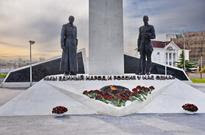


In honor of the innocently murdered Cossacks who suffered from genocide after the revolution, prayers were held in the churches of St. John the Warrior in Vladikavkaz and Alexander Nevsky in the village of Arkhonskaya. On the territory of the Terek region for twenty years, more than 12,000 people, including children and the elderly, have suffered. Many were sent into exile. In memory of the 101st anniversary of those tragic events, a motor rally was also organized.
Andrey Perevoznikov, ataman of the Arkhonsk stanitsa Cossack society: “The villages of Vorontsovo-Dashkovsk, Tarskaya, Sunzhenskaya were evicted. Archonskaya, Ardona's farm, Khristianovskaya, Nikolaevskaya and Zmeiskaya were terrorized. Through all these villages, we make a cross-country rally with the relics of St. Sergius of Radonezh, Alexander Nevsky, Kirill and Mary. It is necessary to honor the memory, especially since we live in a region where everyone always remembers their dead. "
On March 13, the Cossacks of the Regional Representation of SKVRiZ in the Republic of Adygea, headed by their ataman, head of the department of the Tsargrad Society, Sergei Fomin, plunged into the atmosphere of the Civil War. On the fields near the village of Vyselki, Krasnodar Territory, a reconstruction of the battle of the First Kuban campaign ("Ice" campaign) took place. Historical clubs in Moscow, Kuban and other regions of the country with the participation of Cossacks and representatives of various public Cossack associations reproduced the battles between units of the Volunteer and Red armies.
All participants in the reconstruction were armed with blank weapons. From the memoirs of the hero of the Civil War, General Bogaevsky AP: “... For the entire 2½-month“ Ice campaign ”, among the fifty battles that we had to endure, the battle for Vyselki, early in the morning of March 3, left in my memory the most heavy recollection ... We took Selenium, but at the cost of some desperate efforts and sacrifices! .. "
The organizers of the reconstruction made strict demands on the appearance of the participants. They must wear uniforms and equipment from the period 1914-1918. But the use of elements of the form of the imperial army, volunteer chevrons with the colors of the national flag, stripes, chevrons and shoulder straps of shock units of the 1917 model were also allowed. Those who were in the role of the Red Guards cannot used cockades on their headdresses in the form of a red star and insignia of the command staff of the Red Army of the 1918-1922 model, as well as "budenovka". Recall that by order of the Revolutionary Military Council, "Budennovka" became an official winter headdress only in January 1919.
"On the distant approaches, the Partisan and Consolidated Officer Regiments lay down from heavy machine-gun fire and are preparing to meet the attack of the Reds. The Reds are attacking. White volleys force the sailors and Red Army men to retreat to their positions. After that, until the Reds were entrenched, the regiments unanimously attack the Reds' defense, hack into it and occupy the first line. The Reds retreat to the second line. The field of a short skirmish between the lines of the Reds and Whites, Partizansky and Consolidated Officer, at the command of the commanders, attack the second line of defense, engage in bayonet battle with the sailors and the Red Guards. They win and try to occupy the third line of defense on the move. But there the Red forces have two machine guns that stop the desperate attack. White retreats to the second line, the Reds consolidate at the third, last line. After some lull, both white regiments begin the last battle, where after 2-3 attacks the last one follows, where the red forces are partially killed, partially surrendered."


President Vladimir Putin signed a decree on March 5th appointing Anton Sirotkin ataman of the Black Sea Cossack army. The document was published on the official portal of legal information.
Sirotkin, who is a member of United Russia, holds the position of adviser to the head of Crimea, Sergei Aksenov.
Recall that the Black Sea Cossack army was created at the beginning of last year to unite the Cossacks of Crimea and Sevastopol.

On February 24, Estonia celebrates Independence Day, recalling the 1918-1920 war that Estonia waged against the communist RSFSR. For many, both in Estonia and abroad, the role of the Russian North-Western Army of General N.N. Yudenich in that war is unknown.
That is why, with the blessing of Vladyka Lazar, Bishop of Narva and Chuddin, February 24 of this year. In Narva, at the memorial to the North-Westerners at the Russian military cemetery in the Sivertsi region, a memorial service was served for the White soldiers who fell in battles and died from typhus in late 1919 - early 1920. (The memorial was restored with private donations, in 2006-7, 6 granite slabs with the names of 722 soldiers of the NWA were installed at the expense of the Muscovite Alexander Makarov. In total, from 3500 to 5000 soldiers and officers of the army of General N.N. Yudenich are buried there).
Link to the video
https://www.youtube.com/watch?v=4AE1BJ-Zfsw


The Russian Imperial House announced the upcoming wedding of Grand Duke Georgy Mikhailovich to the hereditary noblewoman from Italy Rebecca (baptized Victoria Romanovna) Bettarini. Metropolitan Barsonuphius of St. Petersburg and Ladoga gave Victoria Romanovna Bettarini on the day of her accession to Orthodoxy the icon of the Heavenly patroness, St. Victoria of Rome. Saint Petersburg, 12 July 2020. Indeed, for monarchs, marriage is not only a private matter, but also a question of continuing the Dynasty. And in our Russian case, when the Romanov Dynasty has only one and only legal heir, this issue is of particular importance. 


Prayer service in memory of the Council of New Martyrs and Confessors of the Russian Church and laying a wreath at the monument to Admiral A.V. Kolchak, in honor of the 101st anniversary of his death, took place in Irkutsk. This was reported on February 7, 2021 by Oblastnaya.
The event was held by the Irkutsk Cossack military society. On this day (January 25, O.S. style), the Holy Church commemorates all the departed who suffered for the faith of Christ.
- Today the Cossacks of Irkutsk and the Irkutsk region have gathered here to honor the memory of the remarkable naval commander, Arctic explorer and Supreme Commander-in-Chief Alexander Vasilyevich Kolchak. This is a person who chose his fate and did not betray it. 101 years ago, here, at the confluence of the Ushakovka and Angara rivers, his earthly journey ended. A difficult life befell this man. But he was always faithful to duty and to his Fatherland. Life turned so that brother went to brother, father to son. And this is a great lesson for us. We must no longer allow this to happen. Nor should the roots of our historical memory, the memory of our Cossacks be severed. Without roots, the tree will fall and dissolve into oblivion, our Fatherland. Today here we, the Irkutsk Cossack Society, commemorate Alexander Vasilyevich. The regional branch of the Union of Cossacks of Russia is with us. Together we serve for the good of the Motherland for the Orthodox faith.


GRAND DUK GEORGE MIKHAILOVICH MET WITH METROPOLITAN OF CHELYABINSK AND MIASS GRIGORY. On February 5, 2021, the Chelyabinsk diocesan administration was visited by E.I. Heir to the Tsarevich and Grand Duke Georgy Mikhailovich. The visit began with a visit to St. Simeon's Cathedral. Accompanied by the secretary of the Chelyabinsk diocese, Mitred Archpriest Igor Viktorovich Shestakov, the August guest examined the exhibits of the parish museum of the history of Orthodoxy in the South Urals.


