7/2/21

Cossacks of the Irkutsk region honored the memory of Kolchak


Prayer service in memory of the Council of New Martyrs and Confessors of the Russian Church and laying a wreath at the monument to Admiral A.V. Kolchak, in honor of the 101st anniversary of his death, took place in Irkutsk. This was reported on February 7, 2021 by Oblastnaya.

The event was held by the Irkutsk Cossack military society. On this day (January 25, O.S. style), the Holy Church commemorates all the departed who suffered for the faith of Christ.

- Today the Cossacks of Irkutsk and the Irkutsk region have gathered here to honor the memory of the remarkable naval commander, Arctic explorer and Supreme Commander-in-Chief Alexander Vasilyevich Kolchak. This is a person who chose his fate and did not betray it. 101 years ago, here, at the confluence of the Ushakovka and Angara rivers, his earthly journey ended. A difficult life befell this man. But he was always faithful to duty and to his Fatherland. Life turned so that brother went to brother, father to son. And this is a great lesson for us. We must no longer allow this to happen. Nor should the roots of our historical memory, the memory of our Cossacks be severed. Without roots, the tree will fall and dissolve into oblivion, our Fatherland. Today here we, the Irkutsk Cossack Society, commemorate Alexander Vasilyevich. The regional branch of the Union of Cossacks of Russia is with us. Together we serve for the good of the Motherland for the Orthodox faith.


Read more »

5/2/21

Tsarevich visits the Metropolitan of Chelyabinsk

GRAND DUK GEORGE MIKHAILOVICH MET WITH METROPOLITAN OF CHELYABINSK AND MIASS GRIGORY. On February 5, 2021, the Chelyabinsk diocesan administration was visited by E.I. Heir to the Tsarevich and Grand Duke Georgy Mikhailovich. The visit began with a visit to St. Simeon's Cathedral. Accompanied by the secretary of the Chelyabinsk diocese, Mitred Archpriest Igor Viktorovich Shestakov, the August guest examined the exhibits of the parish museum of the history of Orthodoxy in the South Urals.


Read more »

26/1/21

General Vladimir Oskarovich Kappel, commemorative events in Moscow


On January 26, 2021, on the day of memory of the General Staff of Lieutenant General Vladimir Oskarovich Kappel, commemorative events took place at his grave in the Donskoy Monastery in Moscow. A memorial service was served for the now remembered generals Vladimir Kappel and Alexander Kutepov, as well as for General Anton Denikin and the philosopher Ivan Ilyin who had reposed near them. The traditional "Zarya" ceremony was performed by naval cadets. The officers of the ROVS held a memorable roll call of the participants of the Great Siberian Ice Campaign.
At the end of the roll call, the floor was given to the guests of honor: Chairman of the "Heritage of the Empire" Association L.P. Reshetnikov and co-chairman of the Skobelevsky committee A.N. Alekaev. White roses from the ROVS and "Heritage of the Empire" were laid at the grave of Vladimir Oskarovich.
This event took place on the initiative of the Moscow branch of the ROVS, with the active support of the Moscow cadet classes of Tsarevich Alexei and the Heritage of the Empire Association.
Moscow branch of ROVS

Read more »

24/1/21

Tributes in memory of the Cossacks killed during the years of the Bolshevik terror held

In January 24, events were held throughout the country in memory of the Cossacks killed during the years of the Bolshevik terror. Members of the regional branches of the Tsargrad Society also took part in these events.
So, in the village of Starocherkasskaya, a procession was held, in which Cossacks and atamans of SKVRiZ and VKO VVD took part. In Crimea, the activists of "Constantinople" together with the Cossacks of the Black Sea Cossack army defended a prayer for the victims of decossackization, after which they laid a wreath at the monument to the killed Cossacks.
Mourning events and funeral services were held in other cities: Ryazan, Yoshkar-Ola, Astrakhan, Kirov, Ulyanovsk, Orel, Lipetsk, Kurgan, Belgorod, etc. In Moscow, in memory of the killed Cossacks, a service was held in the Cossack temple Joy and Consolation on Khodynka field , which was also attended by members of our Society.


Read more »

17/1/21

Nou llibre sobre la segona campanya de Kuban de l’exèrcit de voluntaris

A Rússia s'ha publicat un nou llibre sobre la segona campanya Kuban de l'exèrcit de voluntaris: "La segona (II) campanya Kuban. 10.VI - 18.IX.1918" (autor - Igor Nikolaevich Komendrovsky). Aquest és el primer estudi militar-històric detallat de les accions militars de l'exèrcit de voluntaris a les regions de Kuban i Stavropol l'estiu de 1918, durant la Guerra Civil Russa. Aquest llibre forma part de la sèrie Exèrcit de voluntaris en combat i campanya. Principis bàsics de la presentació del llibre: La segona campanya de Kuban es divideix en operacions separades, s’analitzen en l’ordre següent: teatre d’operacions, forces i plans dels bàndols, rumb i resultats de les operacions militars per a cada operació. El material es dóna per ordre cronològic. Es presta una atenció considerable a la descripció estadística de les operacions militars de l'exèrcit de voluntaris. Un aparell de referència clar, la presència d’esquemes.Per a l’estudi de la segona campanya de Kuban, a més de documents publicats, memòries i investigacions, es van utilitzar materials procedents dels arxius del GARF, RGVA, GARO, TsDNIRO i GAKK. L’apèndix conté una sèrie de materials inèdits: fragments dels manuscrits de V.G. Kharzhevsky, G.K. Kochergin, memòries de B.I. Kazanovich. sobre les batalles prop de Yekaterinodar a l’estiu de 1918, informació i materials analítics. El llibre conté 17 esquemes de colors originals de la segona (segona) campanya de Kuban de l'Exèrcit Voluntari. Sobre aquest tema, l'autor va publicar dos articles a l'almanac "Exèrcit blanc. Escriptura blanca" núm. 14 i núm. 21. Per a aquesta edició, s’han revisat radicalment atraient noves fonts.L’apèndix conté una sèrie de materials inèdits: fragments dels manuscrits de V.G. Kharzhevsky, G.K. Kochergin, memòries de B.I. Kazanovich. sobre les batalles prop de Yekaterinodar a l’estiu de 1918, informació i materials analítics. El llibre conté 17 esquemes de colors originals de la segona (segona) campanya de Kuban de l'Exèrcit Voluntari. Sobre aquest tema, l'autor va publicar dos articles a l'almanac "Exèrcit blanc. Escriptura blanca" núm. 14 i núm. 21. Per a aquesta edició, s’han revisat radicalment atraient noves fonts.L’apèndix conté una sèrie de materials inèdits: fragments dels manuscrits de V.G. Kharzhevsky, G.K. Kochergin, memòries de B.I. Kazanovich. sobre les batalles prop de Yekaterinodar a l’estiu de 1918, informació i materials analítics. El llibre conté 17 esquemes de colors originals de la segona (segona) campanya de Kuban de l'Exèrcit Voluntari. Sobre aquest tema, l'autor va publicar dos articles a l'almanac "Exèrcit blanc. Escriptura blanca" núm. 14 i núm. 21. Per a aquesta edició, s’han revisat radicalment atraient noves fonts.Sobre aquest tema, l'autor ha publicat dos articles a l'almanac "Exèrcit blanc. Escriptura blanca" núm. 14 i núm. 21. Per a aquesta edició, s’han revisat radicalment atraient noves fonts.Sobre aquest tema, l'autor ha publicat dos articles a l'almanac "Exèrcit blanc. Escriptura blanca" núm. 14 i núm. 21. Per a aquesta edició, s’han revisat radicalment atraient noves fonts.


Llibre 2 Les primeres victòries. Volum 1. La segona campanya de Kuban. 10.VI-18.IX.18 Moscou. 2020 348s. 17 combinacions de colors. Tapa tova. RUB 590 (prepagament, inclòs el lliurament a Rússia). Envieu totes les sol·licituds a l’adreça: igorcamenevv@yandex.ru El lliurament es realitza a Rússia i a l’estranger per Russian Post. Pagament a la targeta de Sberbank de Rússia, contra reemborsament és possible. El preu es dóna tenint en compte el prepagament de la targeta; el lliurament en efectiu de reemborsament i a l’estranger es calcula per separat. Rostov-on-Don: la recollida és possible, en aquest cas el cost és de 500 rubles. Si es vol, l'autor pot signar el llibre.


Contingut del llibre Komendrovsky Second Kuban campaign. 10.VI-18.IX.18: 

Introducció. La situació militar-política a l’inici de la II i Kuban campanya 10 (23). VI-18.IX (1.X). 1918: Rússia soviètica. - Exèrcit de voluntaris. - "Campanya del Volga" de l'Exèrcit de Voluntaris. - Kuban i el nord del Caucas. - República soviètica de Kuban-Mar Negre. Teatre de guerra; Forces de les parts: Exèrcit voluntari: les tropes vermelles del Kuban, Stavropol i Don;

Capítol 1. Juny. Operació comercial i gran duc de l'exèrcit de voluntaris. 10.VI - 15.VI.1918 - Batalles pel comerç. 10-12.VI.: Plans i forces de les parts: Exèrcit de voluntaris: tropes de la República de Kuban-Mar Negre i del territori de Stavropol. - El curs de les hostilitats. 10 de juny. 11 de juny. 12 de juny. - Lluita a la zona del pont Kazenny (riu Manych) - Resultats. L'ofensiva contra el gran duc. 15.VI. - Plans i forces de les parts. - El curs de les hostilitats: el centre de la posició, el flanc dret i esquerre - Resultats.

Capítol 2. Juny. Operació de Tikhoretsk. 18.VI - 1.VII 1918. - Plans i forces de les parts. - Batalles per Peschanokopskaya 18 - 20.VI. - Ofensiva contra l’argila blanca 22 - 23.VI. - Batalles al sector nord del front 18 - 25.VI. - La situació al front abans de l'atac a Tikhoretskaya el 28.VI. Forces i plans de les parts. - "Incursió de Borovsky" del 28 al 30 de juny. - Assalt a Tikhoretskaya 1.VII. - Resultats.

Capítol 3. Juliol. L'ofensiva de l'exèrcit de voluntaris a la regió de Kuban i al territori de Stavropol. 3 - 15.VII.1918 - Operació Kushchevskaya 5 - 10.VII i persecució del grup Sorokin 11 - 13.VII - "Desembarcament de Yeysk". 11.07. - Operació caucàsica de la 2a Divisió d’Infanteria. 3 - 9.VII. 1a operació Armavir 2a pd. 12 - 15.VII. - Promoció de la tercera carretera en direcció Yekaterinodar. 3 - 13.VII. - Direcció Stavropol. 2 - 14.VII: Primera defensa de Stavropol. 10-13 VII. - Resultats.

Capítol 4. Juliol. Les batalles de l'exèrcit de voluntaris a la part central de la regió de Kuban i el territori de Stavropol. 14.VII - 3.VIII.1918: Plans, forces i ubicació de les parts; Operació Ekaterinodar. 14.VII - 3.VIII.1918: batalla de Korenovsk. 14 - 23.VII. - L’equilibri de forces en direcció Yekaterinodar. - El curs de la batalla. Primer pas. 14-17.VII: Batalla per Dinskaya. 14.VII. - Contraofensiva del grup de Sorokin. 14-17.VII. - Lluita per Korenovskaya. 16-17.VII. - Batalles a Ekaterinodar i altres sectors del front. 15 - 18.VII; El curs de la batalla.

Segona fase. 18-23.VII: Berezanskaya-Zhuravskaya 18-19.VII. - Platnirovskaya 18.VII. - Defensa Korenovskaya 3 pd. 18-19.VII. - Berezanskaya-Zhuravskaya. 19-23.VII; L'atac a Yekaterinodar. 24.VII - 3.VIII - La situació al front, forces i plans de les parts - Zhuravskaya-Korenovskaya. 24-25.VII - Persecució de tropes soviètiques. 26-29.VII: operació Ust-Labinsk de la 3a divisió. 26-29.VII - Assalt de Yekaterinodar 1 - 3.VIII. - Resultats; Direcció Armavir. 17 - 30.VII.18; La segona defensa de Stavropol 17 - 31.VII.18. - Resultats.

Capítol 5. Agost. Lluites a l'oest i al sud de la regió de Kuban, a la província del Mar Negre i a Stavropol. 4 - 28.VIII.: Persecució de les tropes soviètiques 5.VIII - 13.VIII.1918. Plans, punts forts i ubicació de les parts; Aixecament al departament de Maikop. Juliol agost; Operació Kuban inferior. 5.VIII - 13.VIII.1918: Plans i forces de les parts. - El curs de les hostilitats. 5 - 11.VIII. - Verkhnebakanskaya. 12.VIII. - Novorossiysk. 13.VIII. - Resultats. Ps "L'opció de Sorokin". - "Corrent de ferro". Persecució de l'exèrcit de Taman. 13 - 19.VIII.1918: Plans, forces i ubicació de les parts. - El curs de les hostilitats: els tamans - a Tuapse! 13.VIII - 19.IX. Persecució de l'Exèrcit Roig del Nord Caucàsic a la regió de Trans-Kuban. 4 - 25.VIII.18: plans de les parts - Forçar el primer cd de Kuban. 4 - 13.VIII. Fracàs a Ust-Labinskaya 7 - 8. VIII. - Organització de les tropes del districte militar de Belorechensk.- Persecució del grup de Sorokin. 14 - 22.VIII. - Contraofensiva de l'Exèrcit Roig del Nord Caucàsic. 22-23VIII. - Lluites al departament de Maykop. 20 - 26VIII: Activació dels rebels Morozov i Gaiman. "Rierol de ferro": travessant la principal dorsal caucàsica de la 1a columna de l'exèrcit de Taman. 20 -27.VIII - CD Raid 1 Cube a Belorechenskaya i Maykop. 20 - 26.VIII; Armavir "davant". Agost de 1918; "Conflicte de Zhlobin". Mitjans d'agost - principis de setembre; Batalles a prop de Stavropol 5 - 28. VIII.1918: Plans, forces i ubicació de les parts. - La tercera defensa de Stavropol. 5-10.VIII. - Contraofensiva de l'exèrcit de voluntaris prop de Stavropol. 11 - 28VIII.: Sector oriental del front. 11 - 14VIII. - Sector occidental del front. 13 - 17VIII. - El sector sud del front. Batalla per Nedremennaya. 17 - 18.VIII. - Nord-est de Stavropol. Agost de 1918 - Regió de Stavropol.Secció nord del front. Agost de 1918 Capítol 6. Agost - setembre. La batalla a la part alta de Kuban. 26 d'agost - 18 de setembre de 1918: Plans, forces i ubicació de les parts. - Sector occidental del front. Operació defensiva Belorechensk 1 CD cube. 26.VIII - 6.IX. - La batalla per Pshekhskaya. 28.VIII. - La batalla per Belorechenskaya. 29.VIII - 02.IX. - Avanç de l'exèrcit de Taman. 03-06.IX. - Resultats. - Ps sector oriental del front. L'ofensiva de l'exèrcit de voluntaris. 26.VIII - 9.IX.18 - Forçant la 3a Divisió d’Infanteria de Kuban. 26.VIII - 2.IX. - Battles for Petropavlovskaya 1st CD. 27-30.VIII. - Conflicte Kislov - Negre. Cap al 05-10 de setembre. - L'atac a Nevinnomysskaya 2 pd. 26.VIII-2.IX. - 2a operació Armavir 3 pd. 4-9.IX. - Batalles per Nevinnomyssk 3-8.IX. - Raid Skins. 30.VIII - 10.IX. - Resultats. La transició de l’exèrcit de voluntaris a la defensa. Sector oriental del front. Batalles defensives de l'exèrcit de voluntaris.Del 10 al 18 de setembre - Operació defensiva Armavir. 10-15.IX - Batalles per Invinnomysk. 10-15 IX. - Pell. 10-15 IX. Sector occidental del front. 5-16.IX. - Lluita per Maykop 5-7.IX.18. - "Córrer cap a Laba" de la 1a divisió Kuban. 8-16.IX. Sector oriental del front: operació Mikhailovskaya de la 1a divisió de cavalleria i la 3a d’infanteria. 18.IX. Regió de Stavropol. Primera quinzena de setembre de 1918; Costa del Mar Negre. Finals d'agost - mitjans de setembre de 1918; Resultats; Ps Opcions alternatives. Finals d'agost - setembre.Costa del Mar Negre. Finals d'agost - mitjans de setembre de 1918; Resultats; Ps Opcions alternatives. Finals d'agost - setembre.Costa del Mar Negre. Finals d'agost - mitjans de setembre de 1918; Resultats; Ps Opcions alternatives. Finals d'agost - setembre.


Conclusió. Apèndixs Apèndix 1. Operacions bàsiques de la segona campanya de Kuban de l'Exèrcit Voluntari. 10.VI - 18.IX.18 Dates - Esdeveniments - Números. Taula. Apèndix 2. Taula sincronista sobre la història de la Guerra Civil a l'Imperi Rus, període V-IX.1918. Apèndix 3. Kazanovich B.I. Lluites en direcció Yekaterinodar el juliol de 1918. // GARF f.5827, op.1. 60. Apèndix 4. Capítol X. Una breu visió general de la vida interna de les bateries de la 3a Divisió d’Infanteria i les seves activitats econòmiques durant la 2a campanya de Kuban el 1918. // Kharzhevsky V.G. Sobre les accions militars de l'Exèrcit Roig contra l'Exèrcit de Voluntaris al nord del Caucas el 1918-1919. GARF f. 5895 op.1 fitxer 17 pp. 23-26. Apèndix 5. Retir amb les unitats Sorokinsky, intent de capturar Tikhoretskaya, abandonament de Krasnodar.// Un fragment de les memòries de Kochergin "Assaigs sobre la guerra civil al nord del Caucas". TsDNIRO f.12 Istpart. op. 3, d.621. ll. 48-58. Apèndix 6. Composició de l'exèrcit de voluntaris. Estiu de 1918 Apèndix 7. L’estructura de l’exèrcit de voluntaris al 10 de juliol de 1918. (segons GARF f.5827 op.1 d.56 Esquema d’organització del benestar del 10.VII.1918) Apèndix 8. Esquema de comunicació del quarter general de l’exèrcit de voluntaris abans del 16 de setembre de 1918. RGVA f.39720 op.1 fitxer 10. Apèndix 9. El nombre donat i la correlació real de forces de les tropes enemigues a la Guerra Civil a Rússia. Llista d’esquemes. Esquema 1. IIa campanya de Kuban. 10.VI - 18.IX.1918 Curs general d'hostilitats. Esquema 2. Operació Comerç-Gran Duc. 9.VI - 15.VI.1918 Esquema 3a. Operació de Tikhoretsk. Batalles per Peschanokopskaya i White Clay. 18.VI - 27.VII.1918 Esquema 3b. Operació de Tikhoretsk. L'atac a Tikhoretskaya. 28.VI - 01.VII.1918Esquema 4. Operació Kushchevskaya. Persecució de les tropes de Sorokin. 06 - 13.VII.1918 Esquema 5a. Operació Ekaterinodar. 14.VII - 3.VIII.1918 Batalla de Korenovsk. 14 - 23.VII.1918 Esquema 5b. Operació Ekaterinodar. 14.VII - 3.VIII.1918 L'atac a Yekaterinodar. 24.VII - 3.VIII.1918 Esquema 6. Operació de Kuban inferior. 5 - 13.VIII.1918 Esquema 7 batalles per Stavropol. 08.VII - 18.IX.1918 Esquema 8. Persecució de l'exèrcit de la república del nord del Caucas a la regió de Trans-Kuban. 4 - 26.VIII.1918 Esquema 9. La batalla a la part superior de Kuban. 26.VIII - 15.IX.1918 Curs general d'hostilitats. Esquema 9a. Battles for Belorechenskaya 1 Cd cd. 29.VIII - 03.IX.1918 (portada del títol) Esquema 9b. Forçant la 3a Divisió d’Infanteria de Kuban. 26-31.VIII. Esquema 9c. Contraofensiva de les tropes vermelles del "Front Armavir" 1-2.IX Esquema 9d. L'atac a la 3a línia de front d'Armavir del 3 al 9 de setembre de 1918 Esquema 9d.Batalles per al cd de Maykop 1 Cube. 5-7.IX. "Run to Laba" 1 Cube cd. 8-16.IX. Esquema 9d. Operació defensiva Armavir 3 pd. 12-15 de setembre de 1918


Totes les preguntes i ordres igorcamenevv@yandex.ru- Komendrovsky Igor Nikolaevich Àrea de recerca: la història militar de la Guerra Civil a Rússia.


Read more »

14/1/21

Monument to the Cossacks who suffered from decossackization to be installed in Krasny Sulin

In Krasny Sulin, they want to perpetuate the memory of the Don Cossacks who defended the Don, as well as those who suffered from decossackization. So far, only a model has been made, and the money for the production will come from extra-budgetary sources. The monument already has a name - "Glory, Cossack Sulin!"

- The new element of urban architecture is a sculptural composition, where the oldest Cossacks are in the foreground, followed by the younger representatives of the Cossacks. Behind them there is a cross of St. George with the outline of the temple of Alexander Nevsky, which once stood on the Suli land, the press service of the government of the Rostov region reports.

The temple was built in 1900 for the workers of the local plant and residents of five nearby settlements, at the expense of the owner of the Sulinsky metallurgical plant Nikolai Petrovich Pastukhov. He rented land, and after the end of the term he decided to give the temple to the ownership of the Don Army.

It took two years to erect a stone building that could accommodate a thousand people. After the consecration of the Alexander Nevsky Church, the philanthropist continued to allocate money for the maintenance of the clergy, and nearby he built a parish school for children whose parents worked at his factory.

Services in the temple continued until the 20s of the XX century, and then it was closed. The building was dilapidated and was finally destroyed during the Great Patriotic War, when a bomb fell on the roof and exploded. The local residents did not restore anything, and soon the church was completely dismantled. Small buildings have survived to this day, which are now located on the territory of school №4.


Read more »

23/11/20

North-Western Army monument in Ivangorod restored

The monument was preserved, being the only monument to the White soldiers in Russia in Soviet times. On the 100th anniversary of the North-Western Army in Ivangorod, on June 1, the renovated monument was unveiled and consecrated at the mass grave of White soldiers and civilian refugees from the St. Petersburg province.
In 2019, the 100th anniversary of the founding of the North-Western Army, General N.N. Yudenich (formerly the Northern Corps), and, accordingly, the 100th anniversary of the events of the civil war in North-West Russia, are celebrated. In Ivangorod in Petropavlovsk, the former Narva Znamensky Orthodox cemetery, there is a monument to the Soldiers of the North-Western Army and civilian refugees from St. Petersburg gubernia who died and died from a typhoid epidemic in 1919-1920.
The monument on the mass grave was opened in the period of the First Estonian Republic in 1936 on the initiative of the Orthodox inhabitants of Narva, among whom was the famous Russian writer Vasily Nikimofor-Volgin. It was he who addressed the people of Narva with a call to perpetuate the memory of those who died during the civil war, protecting Narva and its inhabitants, and was buried in this cemetery. To the dead and those who died of wounds, those who died of a pestilence (typhus epidemic), which broke out in Narva and Ivangorod in the spring of 1920, were added.
The monument suffered during the hostilities in 1944, but remained. On the initiative and with the financial participation of the Military Brotherhood of St. Michael the Archangel and the editorial staff of the journal of historical Russia "Mikhailov Day" (S.G. Zirin, Yamburg), the memorial educational center "White Business" (coordinator O.A.Shvetsov, St. Petersburg ), St. Petersburg Mitrofanievsky Union, as well as the descendants of white soldiers living in Russia and abroad, in April-May 2019, the monument was restored.

Read more »

5/10/20

Memorial to Mikahil- Drozdovsky, one of the leaders of the White Armies

A Memorial plaque dedicated to the knight of honor Mikahil- Drozdovsky 1881-1919) has been unveiled Rostov-on-Don. This is another project that saw the light of day thanks to the efforts of A.N. Alekaeva and Beloe Delo. With the Bolshevik seizure of power in the October Revolution and separate peace with Germany, Drozdovsky was forced to resign his commission. He refused offers of a position as commander of an infantry division in late November, and instead contacted General Mikhail Alekseev, who had started an anti-Bolshevik uprising in the Don region. Drozdovsky promised to form a unit of volunteers from troops at the Romanian front and join the White movement. In January 1918 "White Guard" volunteer units were created in Kishinev, and Iaşi in Romania, as well as in Bolgrad in the Odessa region. Colonel Drozdovsky decided to lead his anti-Bolshevik forces east and join the Volunteer Army in its fight against the Red Army in the Don region of southern Russia. On February 26, 1918, despite the actions of the Romanian army, which tried to disarm them, Drozdovsky and his men, numbering around 1100 war veterans (most of them officers), started their march to the Don. On its way Drozdovsky was joined by other officers and soldiers hostile to the new Soviet regime. Drozdovsky's private notes written during the march show him as a patriotic officer who felt that he had no choice but to fight the Bolsheviks—whom he considered the destroyers of Russia. The notes often reveal a sense of doomed resignation. This, however, did not prevent him from acting with great energy and from being an inspiration to his men. On April 21, 1918, Drozdovsky briefly captured Rostov-on-Don.


Read more »

28/9/20

1,500 people in a procession to honour the Russian Tsar Family

About one and a half thousand people from different regions of Russia took part in the Elizabethan procession of the cross, held on Sunday September 27th in the Moscow region, the press service of the organizers of the event, the Elisabeth-Sergius Educational Society (ESPO), told RIA Novosti. The procession dedicated to the Monk Martyr and Grand Duchess Elizaveta Fyodorovna, known for her wide-ranging charity work in Russia, has been held since 2011 on the Sunday closest to her name day. In 2020, the procession is timed to coincide with the 20th anniversary of the glorification of the royal family of the Romanovs in the Cathedral of the New Martyrs and Confessors of Russia and the 10th anniversary of the great consecration of the Church of the Savior Not Made by Hands in the village of Usovo. "This year, about one and a half thousand people took part in the procession, including guests from Alapaevsk, Yekaterinburg and Perm,"- said the press service of the ESPO.


Read more »

18/9/20

The memory of the Grand Duke Sergius Alexandrovich honored in Moscow

On September 17, 2020, in the tomb of the Romanov boyars in the Novospassky Monastery in Moscow, at the grave of Grand Duke Sergius Alexandrovich (1857-1905), the abbot of the monastery, His Eminence Metropolitan Dionysius of the Resurrection, served a requiem. Vladyka was co-served by Hieromonk Nikon (Levachev-Belavenets), head of the Office of the Head of the Russian Imperial House for historical and memorial activities.


Read more »

8/9/20

A bust of the Tsar Nicholas II was installed in the Voronezh region


A bust of Emperor Nicholas II was opened at the entrance to the Church of the Ascension of the Lord in the city of Kalach, Voronezh region. According to local historian Pavel Popov, this is the only monument to the Emperor in the region. The monument was consecrated by the rector of the church, Archpriest Eugene Bey. The territory of the temple, built in 1776, is adjacent to the city market. It's always crowded here. In addition to the monument, the priest consecrated a granite icon "Passion-bearer of the Royal Family", which will later be fixed near the monument.

Read more »

6/4/20

Monument to Soviet Marshal Konev demolished in Prague


The City Hall of Prague early in the morning on Friday, April 3, dismantled a bronze monument from the pedestal to Marshal of the USSR Ivan Konev, who was located on Interbrigad Square in the Dejvice quarter - the center of Prague-6. A new memorial “To the Liberators of Prague” will be erected on this square; a competition for the creation of the monument will soon be announced by the City Hall. Note that local authorities plan to erect a monument there in honor of the Russian soldiers of the ROA, the anti-Bolshevik army led by General Vlasov.

Read more »

5/4/20

Kuban Cossacks who died fighting in Transnistria in 1992 Remembered


Almost thirty years have passed since the spring of 1992, the Kuban volunteer Cossacks went to the aid of their Slavic brothers in Transnistria, where armed confrontation began on the fragments of the disintegrated USSR. Already on March 12, the first hundred Kuban Cossacks, led by the marching chieftain Colonel Alexei Anikin, took part in the battles.

The Kuban Cossacks are connected with Transnistria by real blood ties. It was there that the Black Sea army of the faithful Cossacks was created and almost a decade from the former Cossacks, which later became the basis of the Kuban Cossack army.

In total, about 200 Kuban volunteer Cossacks fought in Transnistria in 1992. Some of them gave their lives for the freedom of the Transnistrian republic. The first, literally on the second day of hostilities, was hit by a bullet Nikolai Petin. And on March 31, journalist and writer Alexander Berlizov died. According to the memoirs of a fellow soldier, on the eve of his last battle, he was extremely excited as if he foresaw the approaching death. But he was not afraid of her, but was preparing to accept him as a real Cossack - with weapons in his hands. In the morning during the battle near the village of Koshnitsy, he was mortally wounded by a shot in the back. Having fallen to the ground, having managed to say: “That's all ...”. A year later, a monument appeared on the grave with the words: “He was a Cossack and fell in battle. For us, for our homeland! ” Behind these words is the whole fate of a historian, a gifted publicist, an honest uncompromising journalist. The whole life of Alexander Berlizov is a feat. It only ended in Transnistria. But his real scientific, civil feat was already shown when he refused in his Ph.D. Alexander was denied protection

dissertations. He did not become a candidate of historical sciences. He became a real hero.

In the battles for the liberation of the city of Bender - the capital of Transnistria - the Cossacks Valery Tatarenko, Alexei Antonov and Sergey Denisov piled their heads - they are buried in their native villages.

Recalling the fighting days of Transnistria, Colonel Anikin names the volunteers who did not flinch, were not afraid of the first baptism of fire. Some of them not only kept the line for 20 days (Cossack brigades changed each other after this period), but also remained longer. Alexander Peshkov - the commander of the first platoon, Alexander Vyatkin, Nikolai Dubrov, the chieftain of the Transnistrian Cossacks Alexander Kucher ...

- In those distant 90s, we were full of the energy of a resurgent Russia, the Cossacks. We defended not only Transnistria, defended a united Russia. We were driven by a desire to save the Power. We gained a new sense of the motherland and the combat experience that was useful to the Cossacks in the Crimea in 2014.

The younger generation Alexei Alexandrovich wants - to know the price of life:

- A Cossack is always ready to give his life in the name of the Motherland. But above this is to survive and protect loved ones. A real Cossack must cultivate the ability to control his feelings and actions ... Then he can defeat the enemy.

After the Transnistrian events, the Cossacks supported the Abkhaz in the Georgian-Abkhaz war of 1992-1993. They explain this high civil impulse by the need to protect the common cultural and Orthodox traditions of the Russian and Abkhaz peoples, the common ethnic roots of the Abkhaz and Circassians, with whom the Cossacks developed friendly relations.

Read more »

21/2/20

A year has passed since the death of the first military chieftain of the Orenburg Cossack army

A year has passed since the death of the first military chieftain of the Orenburg Cossack army (1991-1993) by the Cossack colonel Vladimir Ivanovich Kosyanov.Vladimir Ivanovich was born on September 17, 1953 in a hereditary family of Cossacks, grew up in the village of Krasnokholmsky Orenburg region. He graduated from the Orenburg State Pedagogical Institute. After defending his dissertation, he was awarded the title of candidate of pedagogical sciences. He worked as a director of a secondary school, senior teacher, head of the department of scientific foundations of school management.

Vladimir Ivanovich was one of the organizers of the revival movement of the Orenburg Cossack army: since 1990 he was the chief of military duty (staff), since 1991 the chieftain of the regional army community. He participated in the preparation of the legislative framework for the rehabilitation of the Cossacks of Russia and legislative acts to give the Cossacks state status.

From December 7 to December 8, 1991 at the tourist base of the village of Nezhinka (formerly the village of Nezhinskaya), which is 20 km away. from Orenburg the First big circle (congress) of the Orenburg Cossack army took place.

The congress was attended by over 400 delegates from Cossack communities and communities of the Orenburg, Chelyabinsk, Kurgan, Sverdlovsk regions and Bashkiria. Cossack brothers came from the Kuibyshev and Kurgan regions, Kalmykia, Kuban, Don and other cities and regions of the former USSR.

The large military circle proclaimed the fact of the reconstruction of the Orenburg Cossack army within its historical limits, and also declared its succession right to the entire historical heritage of the Orenburg Cossacks. According to the results of the congress, the ataman of the First Division of the OKW, Vladimir Ivanovich Kosyanov, was elected ataman of the Orenburg Cossack Army. Duties of the military chieftain performed from 1991 to 1993.

Source: Official site of the Orenburg Separate Cossack Society "First Division of OKV"

Read more »

14/2/20

Opening of the first Cossack enterprise of agricultural products

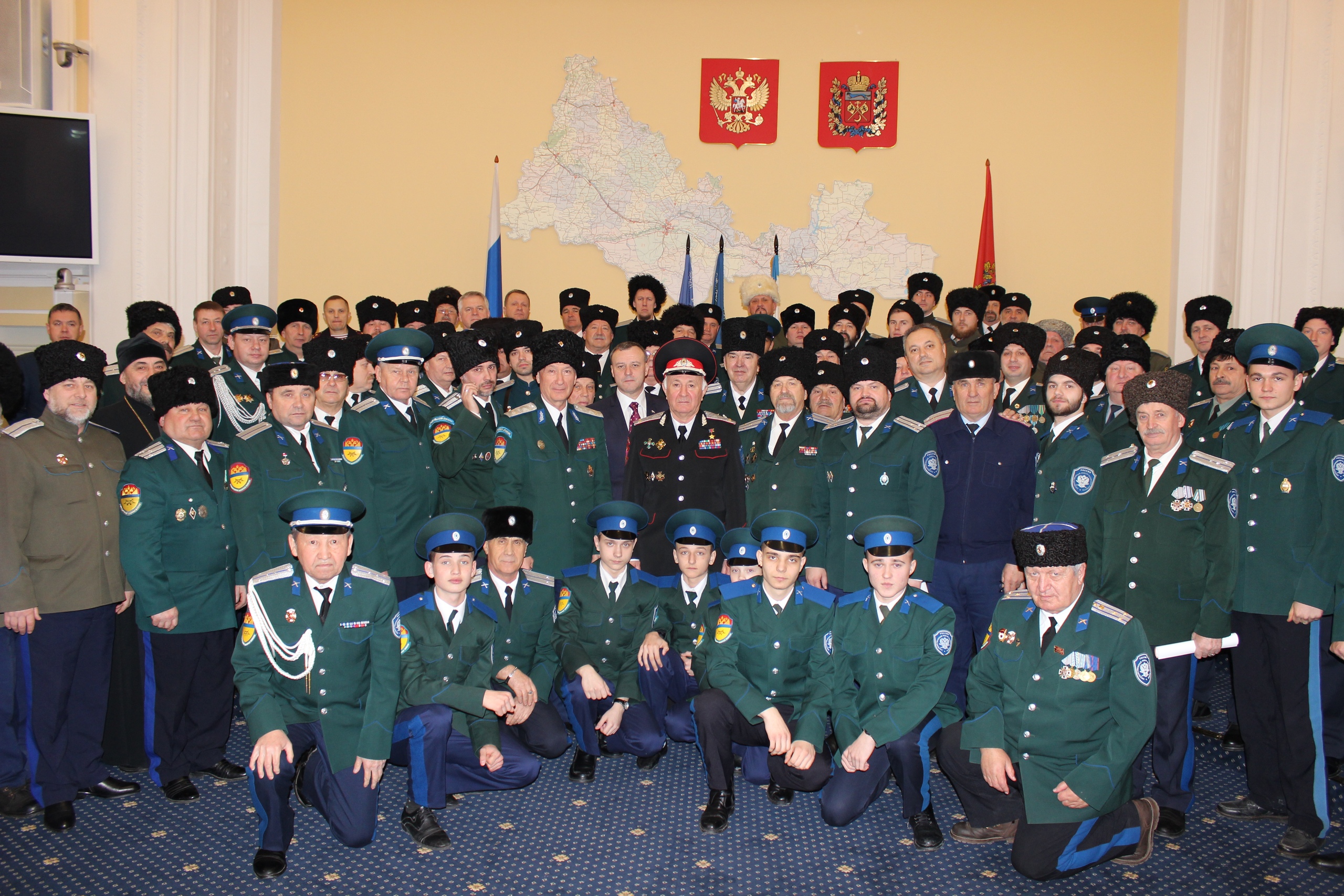
During a working trip, Nikolai Doluda visited a Cossack school, met with the leadership of the region, took part in the opening of the Cossack trade and industrial center “Cossack Compound”. This is the first Cossack enterprise that will be engaged in the cultivation and processing of agricultural products.

According to the chieftain of the First Division of the Orenburg Cossack Army Sergey Slepov, the enterprise will open jobs for Cossacks in late February. The commercial and industrial center will be engaged in the processing and sale of agricultural products. To date, about 64 million rubles have been invested in the organization. Of these, 18 is a grand from the regional budget, the remaining funds were collected by Cossack entrepreneurs.

- We have already opened a store, obtained a license to trade. Contracts for the supply of products were signed with ten farmers. There is a deboning shop, equipment for baking, a smoked meat machine small, but the productivity is 200 kg per shift. These are dumplings, and dumplings, and khinkali, - Sergey Slepov told. - In the near future it is planned to open a round-the-clock cafe, things are moving, as they say, on the thumb, because in Yekaterinburg the Cossacks already have such a practice. Special equipment purchased for 2 million rubles. Chelyabinsk, Ufa work on the same machines. The total area of ​​the hypermarket is 700 square meters. It differs from chain stores in that there will be environmentally friendly products made by Cossack farmers and their families in the Orenburg region. Most of the meat, poultry in raw and smoked form, lard of various preparations, sausages, cheeses, dairy products.

Having visited the first Cossack enterprise, Nikolai Doluda noted that it is an example to follow for all troops.

- To date, the situation has developed in such a way that regional and municipal authorities provide financial assistance to almost all Cossack societies, however, this is not enough, - Nikolai Alexandrovich believes. - Any Cossack society should have its own economic base. That is why we fought so hard to change the land code of the Russian Federation, and in 2015 we achieved this. Now, land can be allocated to the registered Cossack troops without bidding. And what I liked in the Orenburg region - here we go further! A regional law has been adopted here, which allows to allocate land not only for agricultural land, but also within the boundaries of settlements for agricultural processing. There is no such experience in organizing additional income for Cossack societies in any region, and I will talk about this in all registered Cossack troops.

Service improvement

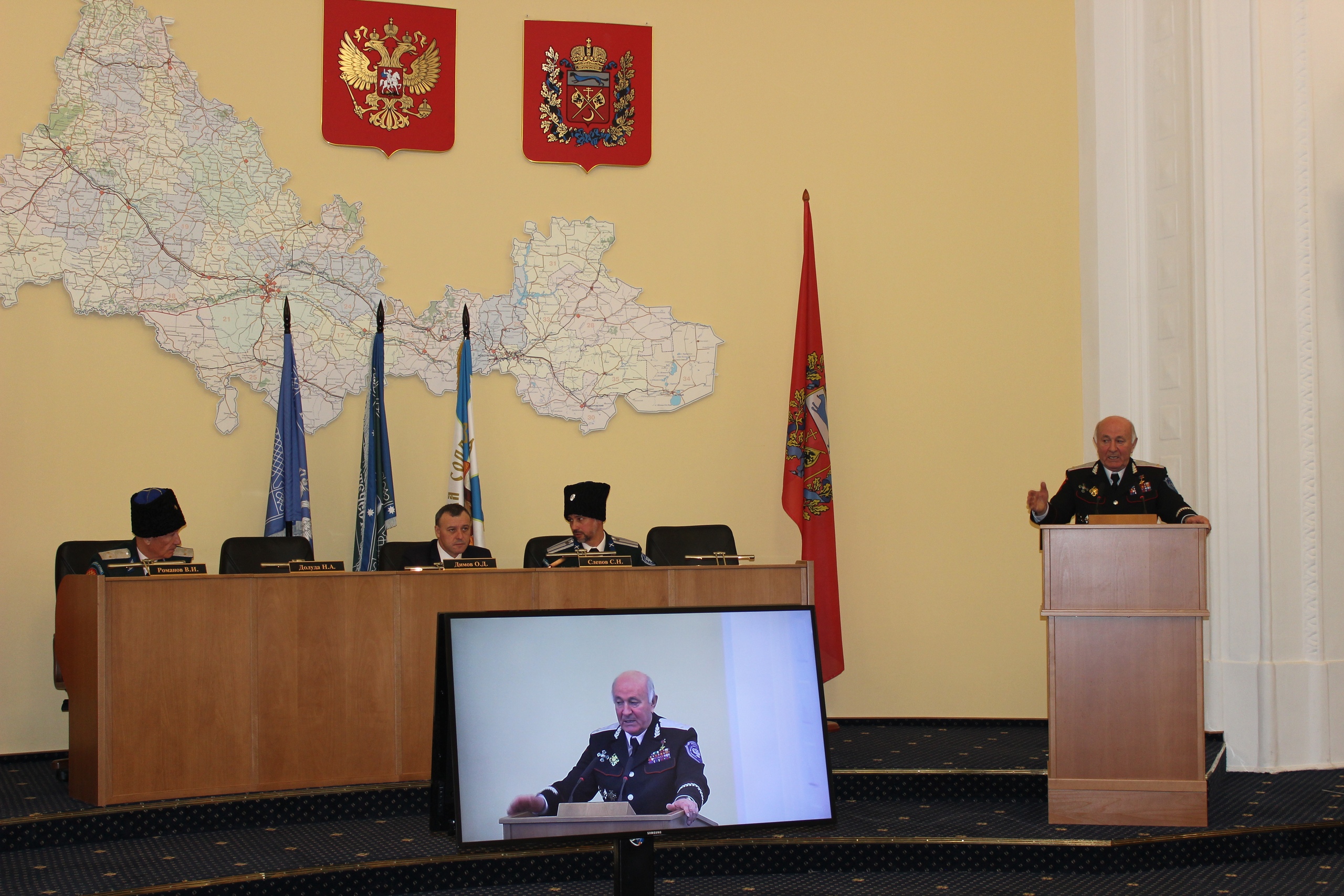
Nikolai Doluda also participated in a meeting of the Council of Atamans of the First Division of the Orenburg Cossack Army.

- The management set a task for me - to travel around all the registered Cossack troops and see how the state service of the Cossacks and the system of patriotic education of the younger generation are organized on the ground. Everywhere things are different, and it all depends on how much the local authorities are interested in the development of the Cossacks, ”says Nikolai Doluda. - Today I became convinced that the municipal authorities allocate material assistance to almost all Cossack societies. But this is not enough. Any Cossack society should have its own economic base. Land is the real estate that makes a profit. It's great. The Orenburg Cossack army has every chance of becoming one of the best operating Cossack registry troops in the country, ”Nikolai Doluda said at a meeting of the Ataman Council.

Despite a good assessment of the work of the Orenburg Cossacks, the chieftain noted the absence of their own headquarters.

- I saw the conditions in which the chieftain of the First Division of the Orenburg Cossack Army works, and I evaluate them extremely negatively. Having been in other troops, I have not met anywhere so that the chieftain of the department, where about five thousand Cossacks, was placed in two offices. The Orenburg Cossack society is located on the territory of five constituent entities of the Russian Federation, four of which are some kind of donors with great potential in providing assistance, the chieftain emphasized.

Nikolai Alexandrovich said that 15 thousand Cossacks for such a strong Cossack organization are very few, should be at least twice as many.

The chieftain paid particular attention to compliance with the norms of wearing uniforms and the insufficient level of organization of the Cossack education system. Indeed, in the region where the historical Cossack roots, there is only one Cossack school and there is not a single Cossack cadet corps.

- One of our main tasks is the struggle for youth. You perfectly understand that if parents, a school, and, to a lesser extent, a street were engaged in raising the young generation, now, unfortunately, things are different. Many children are brought up in single-parent families, the school, alas, does not have the previous authority, and the Internet and the street fill most of the information space. This information is not always useful, the child is not always able to analyze it and draw useful conclusions, - Nikolay Doluda is convinced. - Often, young people are looking for aggression on the Internet, with the aim of making easy money, they get to sites related to fraud. I am by no means against the Internet, as such, we live in an age of high information technologies that are of great benefit, but you need to use it wisely. And traditional education of youth depends on Cossacks.

According to the ataman of the All-Russian Cossack society, the more children will be involved in the Cossack education system, where along with general education subjects are studied the history, culture, traditions and customs of the Cossacks, the more true patriots and morally healthy personalities will grow in our country.

- It is in the system of Cossack education that we lay in the children the main universal principles: respect for elders, love for the Fatherland, to help those in need. It is an honor, conscience, duty and readiness at any moment to defend one’s country, ”says Nikolai Doluda. - By the way, in the educational system of the Kuban Cossack Army, where I was the chieftain for 12 years, there are already more than 100 thousand children who joined the ranks of the Cossack Youth Union. I want to wish you the same result, because children are the key to the future of our Motherland.

New vector of development

At the end of the official part of the meeting of the Council of Atamans, Nikolai Doluda continued the conversation with the Orenburg Cossacks. Vladislav Bondarenko, the chieftain of the Orenburg department of the Union of Cossacks of Russia, asked about the attitude of Nikolai Alexandrovich to public Cossack organizations.

- One of the tasks that are set before me, as the ataman of the All-Russian Cossack Society, and which, at the same time, are approved in our Charter by the President of Russia, is the organization of interaction with public Cossack associations. And I will be obligatory engaged in this direction, - said the military chieftain. - Yes, you do not assume obligations to perform public service, but you are the same Cossacks, like us, you also follow traditions and we have a lot in common, we live in one country. Together we want to engage in the patriotic education of the young generation, improve the system of continuous Cossack education, integrate Cossack traditions and culture into the modern life of society, hold memorials, at which we remember those who fought during the Civil and Great Patriotic Wars. There are so many things that unite us and we don’t need to be on opposite sides of the barricades. On the contrary, we need to go shoulder to shoulder. After all, there are 180 thousand registered Cossacks today, and 650 thousand social activists. Just imagine what kind of power and support the state is!

At the end of the topic of the unification of the Cossacks of Russia, Nikolai Alexandrovich raised the question of the geopolitical situation.

- Unfortunately, somewhere there is still an opinion that American democracy is the best in the world. And what is it? It turns out that she brings discord. In the previously stable countries where this democracy is reaching, local conflicts are beginning to occur, which naturally affect not only the lives of the inhabitants of these states themselves, but also the situation in the world as a whole. Among such countries, as you know, Yugoslavia, Iraq, Libya, Ukraine, the military chief recalled. “Many are trying to get us on our knees.” But no country has yet been able to do this and cannot. I’ll quote the lines of one famous poem: “We are Russians and let the enemy remember forever that only then we get on our knees when we kiss the Russian flag!”

After the speech of Nikolai Alexandrovich, the Cossacks perked up. Ataman of the North-Western Yurt Cossack Society Anatoly Aldukhov thanked the chieftain for his support.

- We are glad that you have arrived, now we have faith in the Russian Cossacks! We are ready to fulfill all your orders. And thank you for your kind words, for believing in us, ”Anatoly Aldukhov addressed the chieftain. - We will do everything to ensure that the Orenburg Cossack army really reaches a new level of life for the Russian Cossacks.


Read more »

9/2/20

Kolchak's memory was honored in several Russian cities

On February 9, 2020, at the initiative of the Voronezh department of the Russian Imperial Union-Order, a memorial service for Admiral Alexander Vasilievich Kolchak was served in the church of the Great Martyr George the Victorious in Voronezh. He served as priest Eugene Smagin. The Imperials and parishioners of the temple prayed for the repose of the soul of the servant of God, Bolyarin Alexander.

On February 7, 2020, at the initiative of the RIS-O Magnitogorsk department, in the presence of the Imperials of the department, a memorial service was served for Admiral Alexander Vasilievich Kolchak on the day of the centenary of his memory in the Cathedral of the Ascension of the Lord.

Other services were held in Ekaterinburg, Saransk and Tula as well as Mosco, the last one on February 8, in Moscow, the Union of Gallipoli Descendants.


Read more »

2/2/20

1st Russian Civil War battle reconstructed


On February 3, 1918 in a bloody battle, which became the first episode of the Civil War on the Don, the partisan detachment of Colonel V.M. Chernetsova, which included cadets, gymnasium students and monarchists. For more than ten years, the Don Memorial Days dedicated to the death of young partisans have been held on the Don in early February.

The memorial events, designed to remind the current generation of one of the most tragic pages in the history of the Don and Russia and to prevent such mistakes in the future, were conceived by officers and cadets of the Shakhtinsky General Jacob Baklanov Cossack Cadet Corps.

According to established tradition, in the Assumption Church of the Kalitvena village, where V.M. was born Chernetsov, a memorial service was held for the cadets, cadets, gymnasium students and realists killed during the Civil War.

Within the framework of the Memorial Days, the battle was reconstructed for the railway crossing at the Glubokaya station, as a result of which most of the partisan detachment died. The head of the detachment again, as in previous years, stood the director of the cadet corps, the elected chieftain of the Great Army of the Don Cossack Colonel V. A. Bobylchenko. This year the Cossacks of the yurts of the Great Don Army and members of military-historical clubs took part in the reconstruction of the battle. The guest of memorial events was E.P. Chernitsov - a relative of Colonel V.M. Chernetsova.

The three-day memorial days in memory of the partisans of Colonel V.M. Chernetsova "battle" under the Monastery tract. In memory of the tragic events of the beginning of the Civil War on the Don, “supporters” and “opponents” of the revolution came to grips. The reconstruction of those events clearly demonstrated to the participants and spectators what terrible consequences radical changes in society could lead to.

Read more »

30/1/20

1st meeting of the Council of Atamans of the All-Russian Cossack Society

In the board of the All-Russian Military Committee, in a historic building located in the center of Moscow, the chief ataman Nikolai Doluda gathered on January 30th  atamans of 11 registered Cossack troops of Russia. The chairman of the Synodal Committee for Cooperation with the Cossacks, Metropolitan of Stavropol and Nevinnomyssky Kirill took part in the work of the council. According to tradition, before the start of the event, Vladyka gave his blessing and read a prayer for a good cause.
Despite the official status, the meeting was held in the format of a lively dialogue. At a friendly table gathered true minded, patriots, those for whom the Cossacks are not just a word, not a formality, but really a way of life.
Team formed
Nikolai Doluda opened the Council of Atamans of the All-Russian Cossack Society, in which he spoke in detail about the goals and objectives facing the registry troops. The atamans reported on the state of affairs in their troops, on how the work was done on performing public service, patriotic education of the younger generation, the system of Cossack education, and the unification of the young generation in the All-Russian Union of Cossack youth. Nikolai Aleksandrovich, as the ataman of the All-Russian Cossack Society, assigned a special role to the issue of the vertical control of the registered Cossack troops.
The members of the Ataman Council discussed problematic issues related to the organization of the Cossack societies, and also jointly found ways to solve them.
- To increase the effectiveness of the work of all the registered Cossack troops, we need to build up work with the advisory body as soon as possible under the plenipotentiary representative of the President of the Russian Federation in federal districts for Cossacks. This interaction will give us the opportunity to participate in national projects, learn about the implementation of the president’s legal acts regarding the Russian Cossacks and other regulatory documents, monitor the implementation of the main provisions of the Development Strategy of the Russian Cossacks in all regions, ”said Nikolai Doluda.
After discussing important tasks and problematic issues, the members of the Council of Atamans approved the composition of the elected bodies and elected the chairmen: the Council of the Old Ones - Cossack Colonel of the Central Cossack Army, Honorary Veteran of the Moscow Region Georgy Bukhtiyarov, court of honor - Cossack Colonel Mark Nafanov, former Chairman of the Council of Old Men of the Siberian Representation Cossack army in Moscow, adviser to the chieftain; Council for Cooperation with Religious Organizations - Father Timofei Chaykin. Ontrol over financial reporting will be carried out by the hereditary Don Cossack, lawyer Yuri Topilin. Thus, the board of the All-Russian Cossack society is fully formed.
Plans for the near future
The First Deputy Ataman of the All-Russian Cossack Society Igor Kazarezov shared with the participants in the Ataman Council information received at a meeting of the Presidential Council for Cossacks on the participation of Cossack societies in significant events. In 2020, among them - ensuring the organization of the passage of two ceremonial calculations of the Kuban and the Great Don Cossack troops in the anniversary Victory Parade on Red Square, participation in the 450th anniversary of the ministry of the Cossacks to the Russian state and in organizing the IV World Congress of Cossacks.
To achieve understanding in fulfilling common tasks, the heads of departments of the Board of the All-Russian Cossack Society talked about the principles of interaction with the Cossack troops, how the mechanism of work of the department for improving public service, international relations, patriotic education and the media relations department is built.
“In the near future I am going to visit all the Cossack troops, the supreme chieftain promised, in order to understand how the implementation of Federal Law No. 154“ On the Performance of Public Service ”is being implemented. Where it is really organized, and where nothing has been done for this. Law is law, and it requires the Russian Cossacks, as before, to serve their Fatherland. Therefore, it is so important that regional leaders and chieftains of all levels understand this. As soon as possible, in those troops where the territory allows, it is necessary to ensure the participation of Cossacks in the protection of the state border.
Youth is the future
In a special way, Nikolai Alexandrovich drew the attention of the chieftains of the troops to the patriotic education of the younger generation.
“This is what the President of the country relies on - how the system of continuous Cossack education is built, where in parallel with the study of general subjects are taught: history, culture, traditions and customs of the Russian Cossacks,” the military chieftain emphasized. - I want to see where the youth Cossack organization really works, and where this movement exists only on paper!
By the way, in August-September of this year, it is planned to hold the Constituent Congress of the “Union of Cossack Youth of Russia”, which will include youth groups from all registered Cossack troops.
- Soon the assistant chief of the All-Russian Cossack Society for Youth Policy will take up his duties. We hope that according to the election results, he will also lead the youth movement, ”Nikolai Doluda announced. - It is planned that the new organization will work closely with Rosmolodezh.
Taking into account the fact that so far the registered Cossack troops have different levels of development and resources, it is important for the chieftain who has united all the troops of the country to understand where the regional leaders organize interaction with the chieftains of Cossack societies and where not.
“The president made it clear that the Cossacks need Russia and it needs to be supported,” Nikolai Alexandrovich said, “but, unfortunately, not all regional leaders understand this. After a certain period of work of the All-Russian Cossack Society, I will prepare an analytical note addressed to the country's leadership, which will include, among other things, these data. You know, the need for our participation in the development of the draft Strategy of the state policy of the Russian Federation regarding the Russian Cossacks for the period until 2030, continued the military chieftain. - In this regard, I am waiting for your suggestions, gentlemen, chieftains!
Nikolai Doluda announced that a meeting of the organizing committee will be held on January 31 to organize the VI All-Russian Forum of Cossacks in Novocherkassk, which, according to preliminary data, will be held in the first half of September.
Ideological vector does not break
Speaking about the political situation in the country, Nikolai Alexandrovich spoke quite categorically with regard to the opposition media. He noted that in many ways the press forms the opinion of the country's inhabitants about the Russian Cossacks. But it is worth remembering that often we are faced with a false idea of ​​reality. For some, the topic of the Cossacks has become a way of dishonest profit. Woe-journalists do not disdain to earn on hype and try to form a common, superficial opinion about Cossacks in the "yellow press" and thereby discredit, discredit the Cossacks as a force that upholds law and order in a country that fulfills state tasks and is the ideological vector of modern Russia .
The first Ataman Council was productive. At the end of the meeting, atamans watched as a good example videos on the organization of the Kuban Cossack army’s civil service work, on the Cossack education system, on the patriotic education of the younger generation on the example of the life of pupils of the Yeisk Cossack Cadet Corps.
- Today is a historic day - the first Council of Atamans of the All-Russian Cossack Society took place. This is an important day in the history of the Russian Cossacks, ”says Nikolai Doluda. - We have worked fruitfully, we have solved many problematic issues, and I am glad that we hear each other and understand, which means we will move in the same direction.

Read more »

25/1/20

Cossacks of the Great Don Army gathered to honor the memory of the Cossacks who suffered during the Civil War


Cossacks of the Great Don Army gathered in the Starocherkasskaya stanitsa to honor the memory of the Cossacks who suffered during the Civil War and repression.
The requiem, held under the arches of the Resurrection Army Cathedral, was attended by Cossacks of the Great Don Army, representatives of the Union of Cossack Warriors of Russia and abroad, the Cossack National Guard , other Cossack public organizations, Cadet Cossack cadet corps, students of Cossack schools. The memorial service was served by the Army Priest of the Great Don Army, rector of the Ascension Army Cathedral, Archpriest George Smorkalov.

At the end of the requiem, the selected ataman of the Great Army of the Don V.A. addressed to the participants. Bobylchenko, commander of the Cossack National Guard N.I. Kozitsyn and First Deputy (Comrade) Ataman of the All-Russian Cossack Society V.P. Vodolatsky. In their speeches, the leaders of the Cossacks were unanimous: the present generation needs to preserve the memory of the tragic events that resulted from the 1917 revolution and not allow the repetition of the tragedy experienced by the Cossack people.

At the end of the requiem, the Cossacks with the Don Icon of the Mother of God, with banners and banners carried an Orthodox procession through the streets of the Starocherkasskaya village to the Preobrazhensky (Ratnensky) church. A memorial lithium was served here for victims of the tale of politics.

Read more »

19/1/20

Cossacks Renaissance veterans on Saratov land dies

On January 19, 2020, at the 69th year of his life, Alexander Nikolayevich Kolomiytsev , one of the Cossacks Renaissance veterans on Saratov land, died. Since 1990, Alexander Nikolaevich, born in 1951, took an active part in the Cossack movement, held leadership positions in various Cossack structures. In the late 1990s and early 2000s he was the chieftain of the Saratov regional public organization “Union of Public Associations of Cossacks” established by him. In the last years of his life, he served as Chairman of the Council of the Old Ones of the Saratov Department of the Volga Cossack Corps.


Read more »