30/11/15

Putin atorga la ciutadania russa a la filla del General blanc Dreier


Vladímir von Dreier fou un General de l'Exèrcit Blanc a la Guerra Civil Russa. Oficial de l'exèrcit imperial tsarista va resistir fins al final de la guerra amb les tropes contrarevolucionàries i es va embarcar a Crimea el 1920 amb els darrers contingents de la resistència.

Refugiat a París, va regentar una vinateria i la seva filla Irene De Dreier va obtenir el segon lloc en el concurs de bellesa entre l'emigració blanca 'Miss Russia' celebrat a París l'any 1936. Irene va escriure a Putin demanant-li poder morir a Rússia doncs el seu pare li va traspassar l'amor cap a la mare pàtria. I volia fer-ho com a ciutadana russa, no com a estrangera. Després de 95 anys d'exili, poc abans de complir els 100 anys, el 15 de desembre de 2015, Irene va ser reconeguda com a ciutadana russa pel govern de Putin.


En un missatge a la televisió russa NTV De Dreier havia demanat la ciutadania explicant que des de la mort de la seva mare no podia parlar rus amb ningú i que sempre s'havia sentit russa. El govern rus va emetre un decret concedint-li la ciutadania el 30 de novembre. És un acte més de rehabilitació dels Blancs en la línic, com destaca The Guardian, de la pel·lícula 'The Admiral' sobre l'almirall Kolchak. El mateix director del film, Andrei Kravchuk, destaca que els Blancs "tenien el que ens manca avui: sentit del deure, honor, moral i una capacitat per mantenir-se dignes i composats en qualsevol circumstància".

Read more »

21/11/15

Commemoració a Saransk dels Exèrcits Blancs


El 21 de novembre, de la RIU-O a Saransk es va commemorar el 95 aniversari de l'Èxode amb un servei en memòria de Rússia en tots els rangs de l'Exèrcit Imperial Rus, els participants del moviment blancs que van caure al camp de batalla en la lluita bolxevisme o que van morir a l'exili.


Read more »

15/11/15

Feodosia va recordar el 95 aniversari de l'èxode dels russos blancs

Feodosia va esdevenir el punt de partida d'un viatge forçat a l'exili. Els actes van incloure una processó per la ciutat encapçalada per popes de l'Església Ortodoxa. Després la processó es va fer una ofrena floral en memòria dels blancs morts. Una representació de cosacs va recordar els qui van patir l'exili forçat com el 52è regiment de Vílnius.


Read more »

"Matèria Blanca" va celebrar l'aniversari de l'inici del moviment blanc

El 15 de novembre de 2015 es va celebrar el 98  aniversari de l'inici del moviment negre a Rússia, a Sant Petersburg per iniciativa de la "Matèria Blanca", amb la participació dels nostres amics celebrar un servei commemoratiu, que a Kyoto en la memòria ocupa Alekseevskaya i Kornilov parts del sacerdot Nikolai Savchenko, Artemy Piyanzov i Andrew Koren'kov.
En la cerimònia es va commemorar els Generals Alexeiev, Kornilov, el Gran Duc Nikolai Nikolayevich  i tots els soldats que van morir per la Fe, el Tsar i Pàtria. 
 

Read more »

12/11/15

Meeting Between the Primate of the Russian Church Abroad and His Beatitude Patriarch Theophilos and the Veneration of Relics at the Holy Sepulcher of the Lord

On Thursday, November 12, 2015, His Eminence Metropolitan Hilarion of Eastern America and New York, First Hierarch of the Russian Orthodox Church Outside of Russia, on a pilgrimage to the Holy Land, visited the Jerusalem Patriarchate, where His Beatitude Patriarch Theophilos III of Jerusalem and All Palestine welcomed him. His Eminence was accompanied by Archimandrite Roman (Krassovsky), Chief of the Russian Ecclesiastical Mission in Jerusalem of the Russian Church Abroad.


Read more »

7/11/15

Placa als morts de l'Exèrcit Blanc del Nord-Est

A la ciutat de Kingisepp/Leningrad (antiga Iamburg) amb l'ajuda de "Matèria Blanca", es va inaugurar una placa commemorativa en honor de les persones enterrades al cementiri dels oficials i soldats de tropa de l'Exèrcit del Nord-oest. Fou el 7 de novembre amb tres plaques de granit.

Dues plaques duien els noms de 22 soldats l'Exèrcit Blanc del Nord-Est NN Iudenitx i AP Rodzianko (vuit d'ells oficials) enterrats aquí a l'estiu de 1919. Els noms de les dues víctimes segueixen sense conèixer-se.

Tots els cossos de les víctimes que van morir al front o a l'hospital de campanya dels soldats blancs van ser transportats per tren des del front a Iamburg. Una banda militar en presència d'una multitud de ciutadans van marxar a la ciutat cementiri ortodox.


Read more »

5/11/15

Mongòlia inaugura un museu dedicat al baró Ungern


El 1920, Mongòlia es va unir a la divisió de la Guàrdia Blanca Trans-Baikal el general baró RF Ungern. Després de lluitar amb les tropes xineses, el 3 febrer 1921 la Guàrdia Blanca i soldats mongols van alliberats de la capital del seu país. Amb l'ajuda del baró Ungern, el país va tornar a ser una monarquia budista independent. Els més brutals batalles amb els invasors van arribar a principis d'abril 1921. Els blancs del baró Ungern i soldats mongols sumaven uns 2.500 efectius front l'esquadra xinesa de prop de 6000 persones. La ferotge batalla va durar tres dies.

El museu conté fotos i la biografia del baró Ungern, descrivint la seva lluita contra els soldats xinesos a Mongòlia. .L'expulsió dels invasors de Mongòlia, i la restauració de la seva independència com a estat budista va ser crucial. Sense ella no hi hauria modern Estat de Mongòlia. L'Ubicació exacte dels combats a Ulan-Haddad, fins fa poc, no se sabia amb precisió. En la investigació recent portada a terme per historiadors russos i mongols, es va trobar el punt exacte, es van restaurar les batalles del curs i van trobar nombrosos artefactes. L'Acadèmia de Ciències de Mongòlia, el 5 de novembre va inaugurar el museu dedicat al baró Ungern.

Read more »

Three separate "Russian Marches"on Russian Day of National Unity

On November 4, 2015, the Day of National Unity, Moscow nationalists held various demonstrations, among them three separate "Russian Marches."

The "Russian March" in Lyublino
A march organized by the ethnopolitical movement "Russians," despite having been banned in advance, began at noon. This year, against a backdrop of prosecution of Russian nationalist leaders, the demonstration was even more of a disaster than in previous years. About 700 individuals participated (or 960, according to the police).
Before the march got going, organizers were ordered to take down banners with Celtic crosses, which were marked as banned symbols. In addition to the Celtic crosses, kolovrats (Slavic swastikas), and "Imperial" flags, Sova staff noted Pamyat flags as well as flags of the radical nationalist WotanJugend.
The march proceeded along its normal route, on Pererva Street in the south-east of Moscow. A group of Orthodox banner-bearers headed the march. Additionally, Sova noted participation by a small number of members of Russian Joint National Alliance(RONA) under the leadership of Oleg Filatchev, a group of pan-Slavists, the "Russian Human Rights League" (or RPP, led by Vladimir Istrakhov), the "Uncompromising Column" led by Ilya Sotnikov, the "Right Column" (a union of activists from Pamyat and the Committee on Nation and Freedom under the leadership of Denis Russky), a "Black Block" of anarcho-nazis (under the leadership of Alexander Samokhin), members of "Russians" (led by YuryGorsky) and other organizations. Among the "Uncompromising Column" were members of the Slavic Force North-West faction, having arrived to the march from Saint Petersburg.
Aleksey Mikhailov (ex-Russian Image) was also observed at the march, along with ex-DPNI Vladimir Yermolaev. "Democratic Choice" activists Andrey Urenyov, Yaroslav Kolobkov, and Vera Pronina were also observed. The same for Deputy Chief of "Democratic Choice," senior Gaidar Institute researcher Sergey Zhavoronkov.
"Down with dictatorship!" was the official motto of the 2015 Russian March. Participants also chanted "Freedom for Alexander Belov!", "Freedom for Aleksey Kolegov!", "Freedom for Dmitry Dyomushkin!", and "We are the Russian march!". The traditional slogans - "Cancel 282!", "Glory to Russia!", "A Russian flag over the Kremlin!", “One for all and all for one” - were interspersed with more political calls: "Russia without Putin!", "Ahead, Russian block!", "Putin is the President of Chechnya!", "Putin is the President of Tajikistan!", "There's Putin, no brains needed,""No mosques - no terrorist acts!", "Glory to the white race!", "ISIS - burn in hell!", "More nationalists, fewer terrorists!", "Replace Serdyukov with Belov, and Putin with Dyomushkin!", "No order in Russia, as long as a Chekist sits in the Kremlin!" (which rhymes in Russian), and so on. Marchers also chanted "No war!", "Glory to Ukraine!", and "Russians and Ukrainians - brothers forever!"
Participants at the head of the column lit flares near the Bratislavskaya Metro station.
One march participant was detained. By the end of the meeting we were aware of seven members of the Black Block having been detained, including their leader, Alexander Samokhin, who was the ex-leader of the "Russians" Ryazan chapter called the “For Honor and Freedom” movement), as well as Vladimir Ratnikov. They were subjected to administrative sanctions under Article 20.2 of the Administrative Code (violation by a participant of a public meeting of the established order of the meeting). Others were charged with use of foul language in a public place, which apparently means sanctioning under Article 20.1 of the Administrative Code (petty hooliganism). Prior to the beginning of the march, one of the organizers, Anton Smirnov, was detained. He was held at the Maryino police station, after which police released him without filing a report.
At the end of the march, Yury Gorsky held a demonstration. Among the speakers were Vladimir Istarkhov and Ulyanovsk activist Ilya Sotnikov, who announced that "Russia will either be Russian, or uninhabited."The Black Block detained leader Alexander Samokhin was replaced by his comrade who was introduced as Konstantin. Well-known Russian nationalist and pagan Dmitry (Div) Melash was also at the demonstration, urging, among other things, those in possession of hunting licenses to start buying weapons.
Gorsky began to read out a resolution as "Russian Orthodox poet" Nikolay Bogolyubov rose to the stage. The "poet" spoke of criminal investigations against him under Articles 280 and 282 of the Criminal Code, before reciting his poem "Russian Sky." After this, Denis Russky (head of the "Nation and Freedom" committee) came to the stage. At this point Gorsky read the resolution all the way through, bringing the rally to an end.


"Russian March - For Russian Revanche" by the Oktyabrskoe Pole Metro
Participation reached about 360 people at a demonstration organized by the "Russian National Front" - "Great Russia" Party, the Russian Imperial Movement (RID), the "People's Militia of Russia" (formerly the "People's Militia in the Name of Minin and Pozharsky," which was banned), the Imperial Cossack Union, the Initiative Group for a Referendum "for Responsible Power" (IGPR"ZOV," formerly the banned Army of People's Will), and others.
The march began from the Oktyabrskoe Pole Metro stop, and ended at the Sсhukinskaya Metro stop, where a demonstration was held. At the middle of the route the column stopped for speeches to be given.
In addition to the organizations named above, participant groups included the Union of Orthodox Banner-Bearers, the Movement for Nationalization and Deprivatization, the Union of the Russian People (Mikhail Nazarov's SRN), as well as members of the "Other Russia" movement, who did not display a banner but handed out party pamphlets and chanted their own slogans. Additionally, members of the "Sober Russia" movement and leaders of the Dry Law Party were seen in attendance.
Prior to the beginning of the march, during the organization of columns, the "Great Russia" leader Andrey Savelyev began shouting, "Russian revanche, make mincemeat of russophobes!" (which kind of rhymes in Russian), "No to migration! Yes to deportation!". During the march, Savelev chanted, "We must tear off the arms and legs of every prosecutor pursuing Russian political prisoners," specifying though, that they should be "torn off" by trial.
Participants in the march chanted "Russian order in the Russian land,""Russian rule for Russia!", "Down with thieves of the Russian people!", "Kiev is a Russian city!", "Moscow is a Russian city!", "As long as we are united, we are invincible!", "The destiny of the Russian is fear and deceit,""Russia without Jews!", "Russian means sober!", "Freedom for Kvachkov!", "Kvachkov to the Kremlin, Chubais to the bench!", "Russian wealth in Russian hands!", "Rus and Serbia are one!", "Russia, Ukraine, Belarus - for a united Rus!" and so on.
Representatives of "Other Russia" chanted "Our MIGs will land in Riga,""Our tanks will be in Prague,""We won't forget Odessa, we won't forgive Odessa!", "Down with the ceasefire, we will take Kiev!", "Nation, will, socialism!", "Russia is everything, the rest is nothing!", "Eat the bourgeoisie instead of bread!", "Suitcase - train station - Israel!", "Glory to the nation, death to enemies!", "Our motherland is Russia, Chinese out of Siberia!", "Migrants today - occupiers tomorrow!" and so on.
Representatives of the SRN chanted "Russian rule is tsarist rule!"
At the end of the meeting, by the Schukinskaya Metro station, IGPR "ZOV" leader Kirill Barabash led a demonstration. The majority of speakers harshly criticized the Lyublino Russian March, accusing its participants of abandoning Russian nationalism.
Orthodox Banner-Bearers deputy chief Valery Levchenko spoke to gatherers about the apocalypse and the coming battle with the antichrist; Vladimir Filin (of the "Movement for Nationalization and Deprivatization"), among other things, protested Russia's military actions in Syria, asserting that Russia's primary military concern should be to protect Russians in Russia and the Donbass.
Additionally, participants in the demonstration were treated to appearances by Orthodox activist-writer Dmitry Yudkin, veteran nationalist Alexander Ivanov-Sukharevsky - who told of an incipient catastrophe for Russians; YuryYekishev (of the "People's Militia of Russia"); ex-LDPR Deputy Nikolay Kuryanovich; Nadezhda, the wife of Vladimir Kvachkov; Elena Rokhlina; Sergey ("the Spider") Troitsky; as well as the Moscow coordinator of the RID Pavel Vasilyev and the head of the Institute of Higher Communitarianism Kirill Myamlin, who asserted that Russians must come out against political parties and against the "usury of the Jews," while suggesting soviets and national interest-free credit for Russians. To overthrow the government which does not respond to the interests of the people, he noted, is not a right but a duty.
Following the reading of a resolution, the march continued to its end.
Kirill Barabash was detained after the march. According to accounts on radical right-wing blogs, the reason for his arrest was the slogan "put the seven underground kings to sleep!" (a reference to Russia's seven oligarchs). Barabash was released after givingwritten explanations to the police.


"Russian March for a Russian World," organized by the "Russian World" movement of Mikhail Ochkin, began around 1:00pm and lasted until about 3:00pm. About 100 participants in the march walked parallel to Olimpiysky Prospekt from the Garden Ring to the square in front of Durov Theater, where a demonstration-concert was held.
Russian National Unity (RNE) symbols dominated the demonstration: flags and armbands, which apparently were distributed to anyone who wanted them, along with flags of the "Cause"("Delo") party and of "Novorossiya."Along with the individual flags on display was one from the neo-Nazi Party of the Revival of National-Social Justice in Russia (PVNSSR). Cossacks of Moscow Cossack Unionalso took part in the event. Sergey Tsiganov, of the "My Yard" movement, was seen in attendance.
Participants chanted "Glory to the heroes - glory to Russia!", "For Bright Rus!", "Glory to Rus - death to enemies!" and so on.
Valentina Bobrova (of "Green Ribbon") ran a meeting at the end of demonstration, with the nationalist patriotic movement "Russian World," an offshoot of the Novorossiya movement, participating. Bobrova reminded attendees of the "sacred trinity of Russia, Ukraine, and Belarus," and explained the need for a separate, third Russian March, regarding the next "litmus test" for Russia after "Novorossiya:" Syria.
LDPR Deputy Maxim Shingarkin promised to give children the "Russian world, which is bigger than these three countries,"orany other, and reminded listeners that Christ was "crucified facing Russia."
Yury Gvozdev, leading supporters of prisoners of conscience, told the audience that his group would act on the basisof"Russian World," and called to collect money for the "associates," neo-Nazi skinhead Vasily Krivets and National-Socialist Union (NSO) "North" member Vladislav Tamamshev. "Glory to Rus!", he declared in conclusion, while throwing the fascist salute.
Among the speakers, Sova staff noted the head of "Russian World" and "Russian Moscow," Gennady Shibanov; the leader of the widows of killed volunteers in Novorossiya and the Donbass; and Aleksey Zakharov of the RNE. Konstantin Klimov of the PVNSSR finishedthe demonstration with the motto"Glory to Rus! Death to enemies!" (Klimov was the first speaker to note the proximity of the demonstration to a mosque and immediately called on attendees to join "Russian World").
There was also a concert: Anastasia Sorokova sang a coupleof songs, while an unknown RNE guitarist sang many more ideological songs.
Valentina Bobrova read the meeting's resolution. Among other things, it resolved cooperation with pro-Russian forces in Europe, called on a ban on government-funded abortions, proposed someanti-migrant measures, called for the nationalization of big business, for amnesty for those convicted under Article 282 of the Criminal Code, and for the criminalization of "russophobia."
As an unknown man by the name of Konstantin shouted various slogans after the resolution, Sergey Andreev of the "Alliance of the Russian World"spoke on"what it is that makesus a Russian world." It was Andreev's position that this would be a counter to the deteriorating morals of the West, including tolerance and godlessness.
The meeting concluded without incident.


By far the largest event on the Day of Russian Unity was the march and demonstration "We are United," held under the organization of the All-Russian People's Front (ONF). The demonstration came at the end of the march.
The event was coordinated to account for 50,000 attendees. Police counted 85,000, while the leaders of the ONF counted 40,000.
By our count, the event included about 30,000 participants, split into 30 columns of 700 to 1,000 people in each. The two largest columns were made up of representatives of the National Liberation Movement (NOD), along with members of the "Tradition, Empire, Government, Motherland" (TIGR) movement, which is a youth faction of the Rodina (Motherland) Party. Representatives of NOD were also present in other columns.
Contrary to claims made before, there was no separate TIGR column with its own symbols on display. Movement leader Vitaly Laktyushin marched in the Rodina column, which included as many as 120 people. Roughly half were young people including those not affiliated with TIGR. One person was noted in the Rodina column carrying a poster with the phrase "Shame on Sergey Parkhomenko - Menial of the NATO Fleet!". Other young people in the Rodina column carried a banner in the imperial tricolor with the phrase "Our Name is Rus!"
One of the more notable parts of the march was the "Anti-Maidan" movement. Participants in the "Anti-Maidan" column included Night Wolves headed by Alexander (Khirurg (Surgeon)) Zaldostanov, carrying a poster with a picture of a bear and the phrase "Banderovets! I'lltearyou apart for my grandfather." Additionally, about a thousand members of the Militant Brotherhood were observed in the column.
About 150 members of the Great Fatherland Party (PVO) under the leadership of Nikolay Starikov. PVO was the sole organization to carry Russian flags with black ribbons in memory of the Russian airliner downed over Egypt. Other participants in the "Anti-Maidan" column included members of the Officers of Russia and the Union of Veterans of Afghanistan. Generally, the "Anti-Maidan" faction included about 5,000 people.
Despite the fact that NOD distances itself politically from "Anti-Maidan," the regional NOD column basically followed the "Anti-Maidan" faction. This was quite a large group including people with black and brown flags and posters reading, "Putin is our national leader,""Misha, figure it out. I'm Russian. Russians are coming" (featuring a bear crushing a snake), "General Prosecutor! We demand an investigation of the 1991 coup!", "Our column against the fifth column," and "Clean up the fifth column!"
The regional NOD faction brought together 1,000 people. Participants chanted "Our country - our rules!"
The march was closed out by representatives of the regions, trade unions, and individual companies and organizations including the Golden Age movement of supporters of Nikolay Levashov, whose bookshad been banned on extremist grounds in Russia.
We also noted "Georgievtsy,"People's Brigade" supporters, members of "Sober Russia" and the "People's Civil Society Council," the "Novorossiya" movement, and so on.
The demonstration ended in a meeting with speakers including Vladimir Zhirinovsky, who declared, "God save the tsar!"


Read more »

30/10/15

A Moscou, es va inaugurar un monument a Nicolau II

El museu d'Armènia a Moscou i la cultura de les nacions, que es troba al complex de temples de la Diòcesi de Rússia i Nova Nakhichevan de l'Església Apostòlica Armènia van obrir un monument al Sant Tsar-màrtir Nicolau II.
 
La iniciativa presentada pel fons de caritat "renaixement del patrimoni cultural" va ser recolzada per la Societat Imperial Ortodoxa Palestina i el cap de la Diòcesi de Rússia i Nova Nakhichevan de l'Església Apostòlica Armènia Arquebisbe Yezras (Nersisyan). El monument commemora als mèrits de Nicolau II com el salvador d'una gran part del poble armeni i el fet històric que, en el començament del desastre, per ordres personals de l'emperador Nicolau II, les tropes russes van participar en la salvació dels armenis. Així, dels 1,65 milions de persones de població armènia de Turquia es va rescatar 375.000, és a dir el 23%.

Read more »

24/10/15

El Tsarèvitx dóna suport a l'annexió de Crimea


El Gran Duc ho ha fet en una entrevista a Komsomolskaya Pravda on recorda que va visitar Crimea el 2013 i anuncia una nova visita així com projectes caritatius per ajudar-la per part de la Casa Imperial. Segons Jordi Vladímir Putin està defensant amb èxit els interessos del país. Extractes en anglès de les declaraciosn del Tsarèvitx:

“I was in Crimea in 2013, I know many people there and I will definitely visit this place again and I hope not only once. We supported Crimea’s accession into the Russian Federation from the very beginning, when they held a referendum. We have cultural and charity projects working on the peninsula. My mother and I will go there again, but not for PR purposes and not for ticking the box, we will do it when the interests of our cause demand it".

“Of course I hear a lot of criticism in Russia’s address, but there are also weighted statements by serious people who understand that no balance is possible in the world without Russia and common recognition of Russia’s great role in the international politics. The Imperial House and most of people who are loyal to us think that Vladimir Putin is successfully defending his country’s interests.”

Read more »

14/10/15

Cinquè congrés internacional de cosacs enmig de divisions


La trobada internacional de cosacs ha destacat el paper de les forces cosaques en la defensa de Rússia i de la seva seguretat externa o interna. Es va celebrar a Novocherkassk, al Don, el 14 d'octubre. Ivan Bezugly ha subratllat que molts cosacs són al front en defensa de Rússia. Posteriorment al congrés s'ha realitzat una marxa que ha acabat amb la crema de les banderes de Turquia i Estats Units així com de retrats dels seus presidents Obama i Erdogan mentre s'hi onejava la bandera tricolor russa. Per primera vegada hi va participar el Patriarca de l'Esglèsia Ortodoxa Ciril. El lema del congrés fou " Els cosacs. Unitat. Església. Pàtria " i l'organització va ser a càrrec de la Unió de Cosacs fundada just fa 25 anys, el 29 de juny de 1990.


Vodolatsky, l'oficialista


El congrés va aplegar 120 delegats que van enfortir els lligams econòmics entre els diferents col·lctius i aprovar mesures per a agilitzar la concessió de ciutadania russa. Els participants, encapçalats per Viktor Vodolatsky, són afins a la facció pro governamental mentre que el sector crític, encapçalat per Vladímir Melinkhov, ha estat prohibit de participar-hi com sí va fer el 2012 on el dirigent cosac crític va eixir com un clar referent.

Melinkhov, anti bolxevic i oposat a la guerra a Ucraïna

Vladímir Melikhov, el promotor de dos museus, un a Podolsk, prop de Moscou i un a Yelanskaya, al centre de la regió cosaca, dedicats als cosacs blancs (anti bolxevics) no hi va ser present. Aquest estiu la policia russa va entrar als museus i va manllevar baionetes, fusells i altra material. Els museus tenen el mateix lema dels cosacs blancs 'Per la nostra Fe, el nostre Tsar i la nostra Pàtria'. El maig les autoritats russes ja van prohibir a Melikhov que viatjés a Lienz (Austria) amb un grup de cosacs per inaugurar una capella en els 70 anys de la matança de 300 cosacs refugiats de la Segona Guerra Mundial a mans dels britànics. Uns 1.200 cosacs blancs restants foren entregats a les autoritats comunistes russes que els van executar. Melikhov ha aixecat un memorial a aquests cosacs a la pròpia Yelanskaya i un altre a l'ataman P. Krasnov un dels líders del moviment blanc. Oleg Shetshov, de White Cause, considera Krasnov i els seus homes com a "herois".


L'ataman Krasnov


                                  Melinkhov al museu de Podolsk

Churekov, i el suport al Donbas

La policia du a terme una investigació contra l'ataman Yuri Churekov, de Caucasus Line Cossack Host, una host no reconeguda per Moscou. Churekov ha abandonat la primera fila del moviment, i ara està detingut pendent ed judici, i ara Sergei Popov, un moderat, dirigeix la CLCH.

El 2014, Churekov, amb Sergei Popov, l´ideòleg del moviment Russian Caucasus Unity van impulsar un partit cosac que van anomenar "germandat". Els dos defensen als secessionistes prorussos del DonBas mentre Melikhov, membre també del partit, està en contra de la guerra a Ucraïna i, tanmateix, de l'annexió de Crimea.

Vídeo del congrés


Read more »

10/10/15

El Tsarevitx es reuneix amb el Gran Mestre de l'Orde de Malta

El Gran Duc Georgii Mikhailovich es va reunir amb E.P.V. Frey Matthew Festing, Príncep i Gran Maestre de la Sobirana Ordre Militar de Sant Joan de Jerusalem (Ordre de Malta). La reunió es va celebrar a Sant Petersburg. Van ser rebuts per Alexander Tkachenko, qui li va parlar de la història de l'església i de la relació entre Rússia i l'Ordre de Malta. Després d'això el tsarevitx va acollir el Gran Mestre i va entregar-li una icona del Profeta i Bautista Joan Baptista i llibres sobre la història de la Casa Imperial russa.


Read more »

9/10/15

Pravoslavie entrevista l'arximandrita del monestir dedicat a la família imperial

El Monestir dels Sacres Màrtirs Reials de Ganina Yama està dedicat a la família del Tsar II. Va ser aixecat al lloc on es van trobar les restes de la família Romanov. Fou el Patriarca Alexis II el qui va impulsar la seva construcció l'any 2000. El diari rus ha entrevistat a l'Arximandrita Pimen (Adarchenko), Superior del Monestir.

Read more »

5/10/15

Rèquiem pel General Iudenitx

El 5 d'octubre a les 15.00 hores a la Catedral de Kazan a Sant Petersburg es va celebrar un servei commemoratiu a l'Heroi Nacional de Rússia, Comandant de l'Ordre de St. Jordi, participant a la guerra russo-japonesa, la primera guerra mundial i la Guerra Civil, el General, Nikolai Yudenich.  

Va morir a les afores de Niça el 5 octubre 1933 i va ser enterrat amb els més alts honors militars a la cripta de la Catedral de Sant Miquel Arcàngel a Cannes. Més tard fou re-enterrat al cementiri rus Kokad (Nikolaev) a Niça.

Read more »

26/9/15

Obre un arxiu de l'emigració blanca russa a París

Restarà a la Maison Russe a Saint-Genevieve-des-Bois, prop de París. Acollirà documents de l'emigració de russos blancs fugits de la revolució bolxevic. Jean de Boyer, el seu director, ha agraït al president Vladímir Putin el suport de Rússia al projecte. Membres de la família imperial i de l'emigració són enterrats en aquesta localitat.

Read more »

19/9/15

Consagrada una placa commemorativa al general Permikina, a Grödig

El 19 de setembre al cementiri militar de les afores de Salzburg - Grödig, es va consagrar una placa commemorativa a l'heroi del Moviment Blanc al nord-oest de Rússia, el creador del llegendari regiment  Talab Divisió 3 de l'Exèrcit Blanc del Nord-oest General Boris Sergeyevich Permikina (1890 -1971).


L'obertura de la placa commemorativa al general Permikina va ser possible gràcies als esforços conjunts de la  Germandat Militade l'Arcàngel Miguel, de White Cause d'Oleg Shevtsov de Sant Petersburg  i la representació a Baviera de la RIU-O.

Read more »

11/9/15

Russian nationalists rallies in Kazan

Nationalists in Kazan held two separate events “in defense of the Russian language.” On September 6, there was a rally “for federal educational policy,” organized by the Society of Russian Culture of the Republic of Tatarstan. Participants in the action included members of the National-Democratic Party (Konstantin Krylov), the Great Russia (Andrey Savelyev), Motherland (Aleksey Zhuravlev), as well as a few others flying imperial Romanov flags. The rally drew between 25-30 people. On September 11, two activists from the Great Russia Party conducted pickets for the same cause.

Read more »

29/7/15

Presidential Library Receives Declassified Documents on Rasputin's Surveillance

The Boris Yeltsin Presidential Library in St. Petersburg have received a unique collection of documents from the Tobolsk State Archives. The 239 declassified documents dating 1914-1916 show the disorder in the Secret Service and other departments of the intelligence service of the time. The documents also contain valuable information of the secret surveillance of Rasputin, which began in 1915. The materials reflect a dramatic financial condition and a poor administration of the police, despite the fact that Rasputin, by contrast, felt confident and had sufficient means.

Most of the documents until recently were classified as "secret," "top secret," "personal," etc. Letters are in handwritten and printed form, some with pencil and ink marks.

"Correspondence with the Police Department, the Tobolsk provincial gendarmerie, district police officers about the organization of agent service" shows that in the difficult time of the World War I secret agents were dismissed due to the under funding, their salaries were reduced, they were offered to serve on a temporary basis. Confirmation of these facts we find in the presented documents. For example, a letter from the head of Tobolsk provincial gendarmerie Vladimir Dobrodeev addressed to his assistant in the Tyumen and other counties, captain Kalmykov of March 7, 1915: "For the salary of secret agents... we are given only 200 rubles per month... In addition, the Police Department offers to spend money with proper frugality, avoiding cost overruns." The answer of captain Kalmikov was immediate: "Of all the agents in my service I find it necessary to keep the "Skilled" and the "Fast" in Tyumen and the "Soldier" in Turinsk. As to the others, they can be either dismissed or demoted."

The correspondence also touched upon the reduction of agents’ salaries: "...reduce the salary of everyone, as much as you acknowledge it possible. When declaring them all of it do not inform them about the real reason for their dismissal or reduction of their salaries, as otherwise, out of selfish motives, they may give you a fictional information, which in no case can be tolerated."

After that the chief Dobrodeev raises the question not only of the value of staff, but also of the reliability of the agents as a whole: "Are your agents reliable? Instruct them to observe complete secrecy, keeping in mind that in some critical cases it is better to step away in a timely manner in order not to prang both the agents and the whole operation..."

In the summer of 1915, by order of the Minister of Internal Affairs of the suite of His Majesty, Major-General Vladimir Dzhunkovsky, there was established secret surveillance of Grigori Rasputin. Under the guise of guards two secret agents were assigned to him, who regularly reported to St. Petersburg Police Department about all travels, visits, and also provided the complete information about the visitors to Rasputin.

The correspondence makes it clear that the secret service was not up to surveillance of Grigori Rasputin, so they repeatedly suffered failures in their work. For example, the head of Tobolsk provincial gendarmerie writes to captain Kalmykov: "We need to find out, for what purpose Rudolf Berg came to Rasputin from Perm." Then he received a response from the agents: "Since Rudolf Berg had stayed only a few hours, it was not possible to find out or what purpose he came to Pokrovskoe to see Rasputin." The next episode is related to the failure of the agents to provide information.

August 25, 1915 Vladimir Dobrodeev writes to captain Kalmykov: "You have been ordered to monitor all activities of Grigory Rasputin and to inform me of everything... I did not receive any report about the outrages that Rasputin had made on the steamer called "Tovar-par." Yet, according to the chief of the province the actual state councilor Stankevich, whom I talked to today, the Tyumen county district police officer had carried out an investigation of this case." The agents reported: "On the boat Rasputin was drunk heavily, behaved outrageously and offered some books, but I did not pay attention to the content..."

Heads of the secret service feared of getting imaginary or incorrect information from their agents, whereby there were extraordinary occurrences. For example, the head of Tobolsk provincial gendarmerie was angered by the obscurity of one of the telegrams received from the agents. It did not indicate the date of Rasputin’s departure for Petrograd. The chief wrote a threatening letter: "From this I conclude that the sergeant Ivan Ivanov, who has been serving as a sergeant for ten years, fulfills his official duties not carefully enough...

Such negligence caused unnecessary correspondence, the report was somewhat late, almost daily, and quite involuntarily 2 rubles 42 kopecks were spent for sending unnecessary telegrams...., causing damage to the treasury." But it soon became clear that the order to collect a penalty and make a reprimand to sergeant Ivanov was unfair, he was innocent of what had happened: the figure was mistakenly omitted by a functionary on duty of the Tobolsk postal and telegraph office, while copying a telegram from the tape. Then the chief of the Tobolsk provincial gendarmerie recognized the injunction as invalidated, and ordered to inform the chief of the office "Dear G. Yerofeyev" about it "in a cautious manner."

While the police investigated the case of the figure missing from a cryptogram and spent breech time for conversation, fighting for a questionable economy, Rasputin traveled by steamers, and finally went away by train in a 1st Class wagon to St. Petersburg.

At the same time it appears that the decrease in salary, reduction of staff, checking the usefulness of the information provided due to mistrust, search for various "clues" to fight with Grigory Rasputin in the background of the events of World War I led to a serious failure. July 22, 1915 it became known of an important and serious neglect of the secret service: "In the kerosene depots in Tyumen on the Tura River there is a wireless telegraph, by which the local Germans and the prisoners spread the information from the theater of war through Saratov," that "the company Br. Nobel replaced the Russian, who served there before by the Germans, that the spread of telegrams is done by a German newspaperman."

Read more »

26/7/15

Reobre un edifici emblemàtic de l'Esglèsia Ortodoxa Russa

La Casa de l'Eparquia (Diocesi) fou inaugurada pel Patriarca Ciril II a Moscou el 26 de juliol en una cerimònia religiosa i el dia següent el president Vladímir Putin va visitar-la amb el batlle de Moscou. Putin va afirmar que Rússia aprèn de les seves victòries i "errades" com ara tancar la casa.

Va ser aixecada el 1901 durant el regnat del Tsar Nicolau II i consagrada el 1902. Després de la revolució fou el lloc on es reunia el Consell de l'Església Ortodoxa Russa. Aquest va restaurar el títol de Patriarca en la persona de Tikhon. Aquest va destacar per la seva posició anti bolxevic i va condemnar l'assassinat de la família imperial però no va marxar a l'exili i va morir a Moscou el 1925. El Patriarca fou canonitzat el 1981.

La Casa fou clausurada el 1922 però des de 1918 ja s'havien prohibit els actes a la mateixa. Els bolxevics la van saquejar. Fou retornada a l'Església el 2004 i ara, restaurada, el successor de Tikhon 'lha reoberta oficialment.

Read more »

15/7/15

60.000 persones marxen en record del Tsar i la seva família

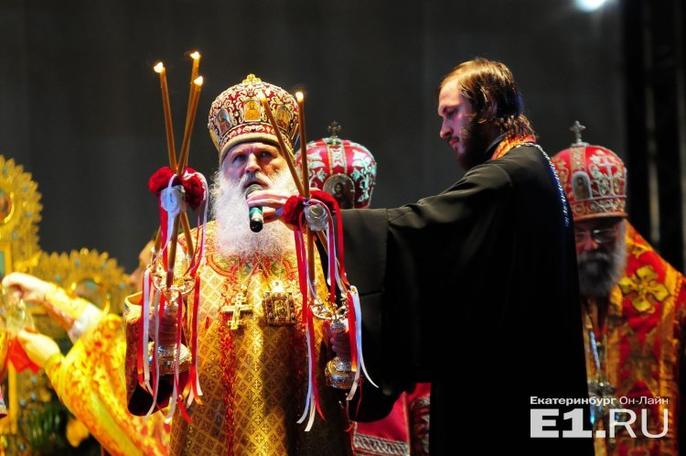
Una immensa marxa, de tres quilòmetres i amb 60.000 persones va coronar els "Dies Reials" a Ekaterimburg. La commemoració anual dedicada a la Família Imperial Russa va desfilar en ordre incloent-hi una delegació monàrquica japonesa. Icones, cosacs i banderes imperials omplien la marxa que va acabar al Monestir dels Sants Màrtirs Reals en Ganina Yama dedicat a la família del Tsar Nicolau II.

Les imatges dels vídeos resum de la marxa nocturna són impressionants.


Read more »